
I walked into a kakuuchi in Kokura with the wrong instincts. I tried to take a stool I’d seen empty, then asked for a menu, then tried to pay at the end with a card. The proprietor was patient, the regulars were not unkind, but I’d done three things wrong inside ninety seconds. Nobody sits, there is no menu, and you pay every time you order. I was treating a liquor store like an izakaya, and a liquor store is not an izakaya.
That’s the whole article in one paragraph. The rest of it tells you what a kakuuchi actually is, why getting it right matters more in Japan than it does in most drinking cultures, and where to go on a trip without making my mistake. The shape of the visit, the etymology that explains the etiquette, the regional names that aren’t interchangeable, the named shops that have done this for ninety years. I’ll get to all of it. The first thing to understand is that the building is the rule.
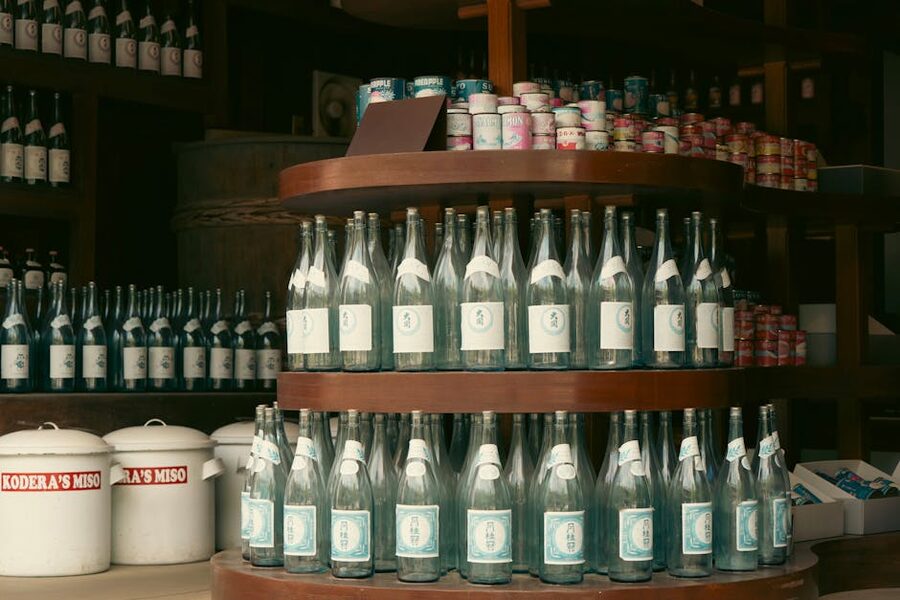
In This Article
- Kakuuchi in one sentence
- The mistake I made, and how to not make it
- What separates kakuuchi from the things it looks like
- The Kitakyushu story
- The proprietor and the silence
- How to pick the kakuuchi to walk into
- Pick the neighbourhood first, the shop second
- Read the door
- Walk in at 17:30, not 21:00
- Six named shops to think about
- Uozumi Saketen, Moji
- Akakabe Sake Shop (Akabe), Tanga Market, Kokura
- Hayashida Sake Shop, Kokura
- Kotani Saketen, Tenjin-Daimyo, Fukuoka
- Koba Saketen, Yakuin Mutsukado, Fukuoka
- Standing Room Suzuden, Yotsuya, Tokyo
- What to drink and what to eat
- The senbero set
- About the food
- The masu, the etymology, and a small drinking detail
- The etiquette I now know
- Cash only, every order
- Don’t sit unless you’re invited
- Pour for others, not for yourself
- Volume control
- Don’t linger past your second drink
- The toilet question
- Don’t photograph the regulars
- The Tokyo revival
- The gender shift
- Where kakuuchi fits in a Japan trip
- Three regional kakuuchi trips worth planning
- Kitakyushu, two nights
- Fukuoka City weekender
- Tokyo half-day
- What kakuuchi gets you that an izakaya doesn’t
- Going home
Kakuuchi in one sentence
A kakuuchi is a liquor store that lets you drink the bottle inside the shop instead of carrying it home. That’s it. The licence under the door is a retail liquor licence, not a food-service licence. The proprietor sells you sake, and you happen to drink it standing in their corner.
Everything else flows from that one fact. There’s no waiter because nobody is waiting on you. There’s no kitchen because retail licences don’t allow real cooking. There’s no closing-out tab because the transaction finished the moment you handed over the coins. You’re not a customer in a bar; you’re a customer in a shop, who is drinking what you bought.
The word kakuuchi (角打ち) is written with two characters: kaku for corner or edge, and uchi for hit or strike. There are two etymology theories and Japanese sources disagree on which is right. The first says you’d put the corner of the wooden masu measuring cup to your lips, drink straight from the angle, and the corner-strike action gave the practice its name. The second is more prosaic: you stood in the corner of the shop (ikkaku, “one corner”) and that corner became the verb. Either way, the connection between corner and drinking is fixed in the kanji. Sake drinkers were the original audience and still mostly are, though most modern shops will pour you whatever’s on the shelf.
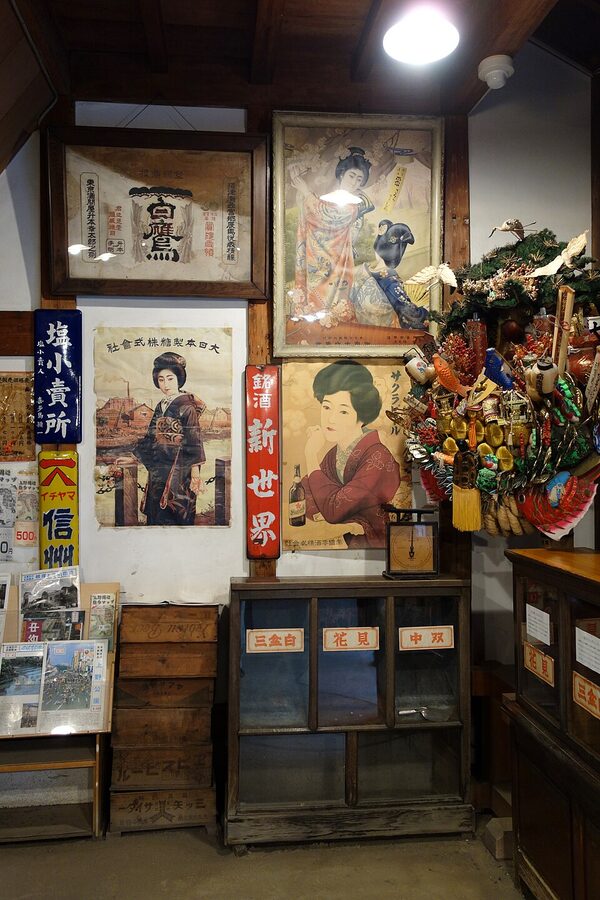
The mistake I made, and how to not make it
I’d come in expecting a Japanese pub. I’d read about izakaya etiquette and arrived loaded up on the wrong rules. So when I walked into Tanakaya Liquor Store on a back street in Kokura’s Kyomachi neighbourhood, I scanned the room for a table, didn’t see a host, and started fishing for a menu. The owner, who’d been quietly stacking nukazuke pickle jars near the till, finally pointed at the fridge and said something I now understand to mean: pick a bottle, bring it here, pay now, drink standing.
What I should have done, in order:
- Stepped inside, said konbanwa, and looked at the actual shop, not for a host.
- Walked to the cooler. In a kakuuchi the fridge is the menu. Cans, cup sake, big bottles, sometimes a few craft beers.
- Picked one drink and one snack from the basket on the counter. The snack basket is dry stuff: rice crackers, dried squid, peanuts in salt-roasted shells, sometimes seaweed crisps. There’s almost always a small fridge with tinned mackerel and pickled cucumber for the heavier eaters.
- Brought both to the counter, paid with cash, and stood at the spot the proprietor pointed me to. Usually a corner of the counter, sometimes a chest-high shelf bolted to the wall.
- Drunk. Eaten. Not lingered.
- If I wanted another, started over: bottle to counter, coins to till, back to my spot.
The rule that catches first-timers hardest is cash-on-delivery. Kyasshu on deribarī is the actual phrase the older proprietors use; younger places sometimes call it otōshi-rei, but the principle is identical. You pay every time. There’s no tab, no slip, no bill at the end. If your wallet is full of plastic and you came in expecting to settle later, you’ve already failed. Carry coins. Carry small bills. ¥1,000 notes are the working currency.
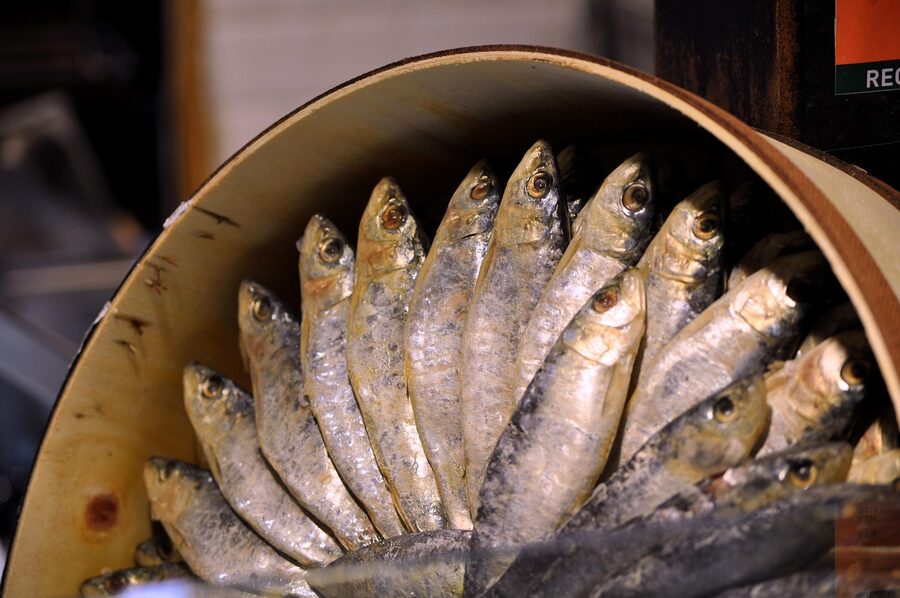
What separates kakuuchi from the things it looks like
A kakuuchi is not a tachinomi. It is not an izakaya. It is not a bar. The differences look small to a visitor and are obvious to a Japanese drinker. Here are the four things you’ll be near and how to tell them apart.
| Place | Licence | Posture | Payment | What you eat | How long you stay |
|---|---|---|---|---|---|
| Kakuuchi | Liquor retail | Standing, sometimes a stool | Cash on each order | Dry snacks, tinned fish, occasionally pickles | 20–45 minutes |
| Tachinomi | Restaurant | Standing, often at a tall counter | Tab or each order | Hot food, sashimi, fried small plates | An hour, sometimes two |
| Izakaya | Restaurant | Sitting, table or counter | Tab, settled at end | Full menu, kitchen serving | Two hours minimum |
| Bar | Restaurant | Sitting at the counter | Tab | Bar snacks if any | Open-ended |
The cleanest test is the licence. A kakuuchi cannot legally serve cooked food the way an izakaya can. Heat is for warming a kettle, not for grilling fish. If you walk in and smell yakitori, you’re in a tachinomi, not a kakuuchi. The smoke is the giveaway. Some hybrid shops blur the line by registering for both licences, especially in central Tokyo. When that happens, the proprietor will usually tell you which mode the shop is in tonight, or you’ll work it out from the menu blackboard outside.
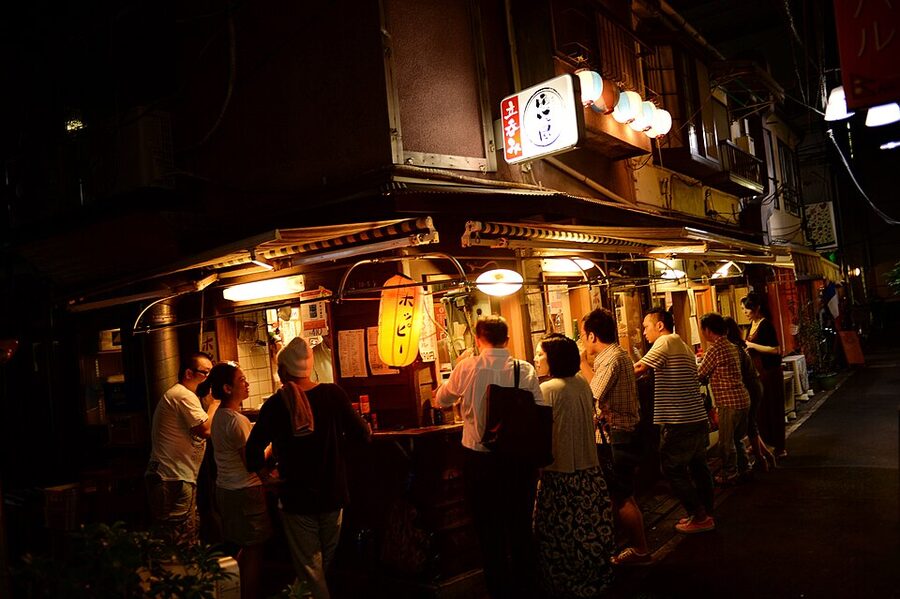

One more layer: the regional vocabulary. The same practice has different names in different parts of Japan, and the names aren’t interchangeable in the way that, say, “pub” and “tavern” are interchangeable in English. Sources I read in Japanese list at least four:
- Kakuuchi (角打ち), the standard national term, originating in Kitakyushu.
- Tachinomi (立ち呑み). In Osaka and the wider Kansai region, this often refers to a liquor-store standing-corner specifically; in Tokyo, it usually means the restaurant-style standing bar instead. Same word, different scope.
- Mokkiri (もっきり), the Tohoku name for the practice, especially on the Pacific side. The word comes from morikiri, “filled to brimming,” because the tradition was to fill the masu cup until sake spilled into a saucer below. Read on if you go to Niigata or Akita: the same picture means a different drink.
- Tachikyū (たちきゅう), used on the San’in coast (Shimane and Tottori). From “stand and gulp”; the practice is identical, the noun is different.
- Tomotsuke (ともつけ), specific to Shimane fishing villages. Tomo means a boat’s stern, and the implication is “stop the boat for one drink.” Niche but lovely; you’ll see it on the door of a few coastal Shimane shops.
The reason this matters: when a Tokyo guidebook says “kakuuchi” they mean the original Kitakyushu thing. When a Tohoku friend says mokkiri they’re talking about a small variation with the spilled-over masu, which is now genuinely rare and worth seeing. If you’re trying to use Google Maps, search the local-language word for the place you’re in.
The Kitakyushu story
The reason the practice has a corner-and-strike name is that it started in a corner. Specifically, the corner of liquor stores around the Yawata Steel Works in northern Kyushu, in the early years after the works opened in 1901.
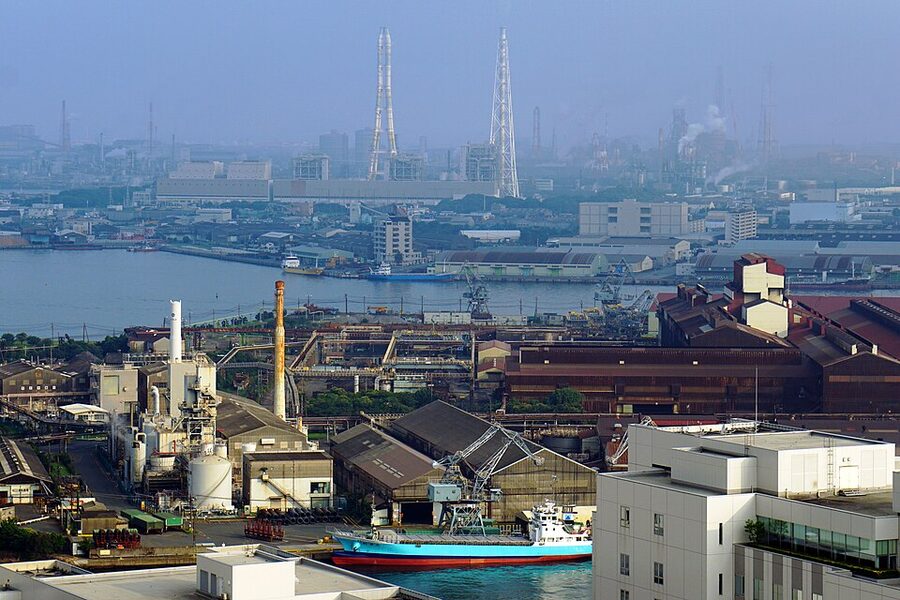

The steelworks ran 24-hour shifts. Workers coming off the night shift at 06:00 wanted a drink before going home, and at 06:00 every bar in the district was shut. The liquor stores, however, opened early because their day-shift customers needed cigarettes and rice on their way to work. So the steel workers went into the shops, asked for a cup of sake, and stood in the corner to drink it. The shopkeeper sold them rice crackers from a basket on the counter to go with it. The arrangement spread because nobody in the system had to do anything new: liquor stores didn’t have to register as restaurants, workers didn’t have to wait for evening, and the off-shift crew got their decompression drink without waiting six hours for the bars to open.
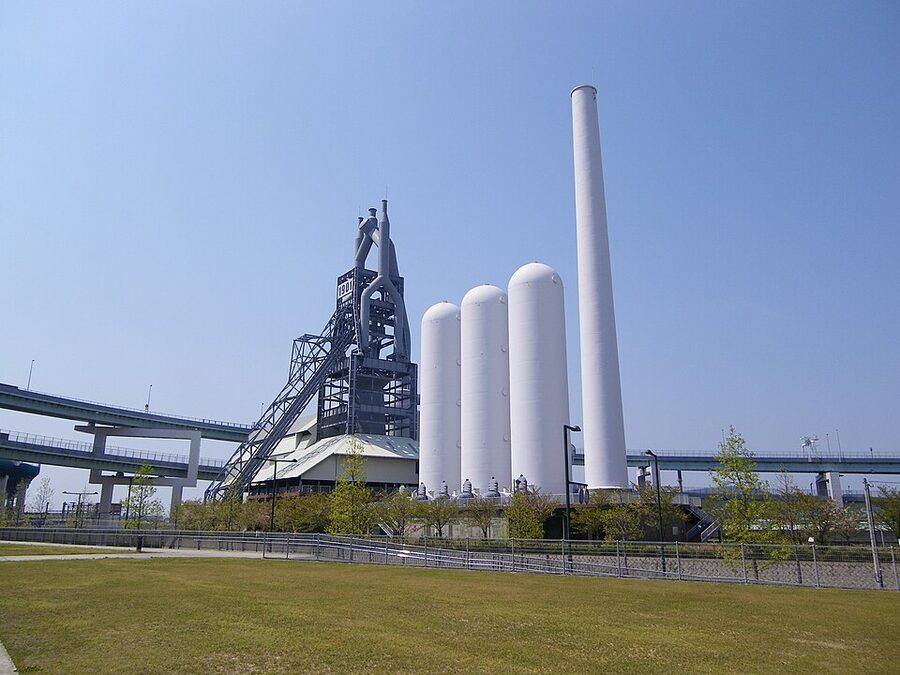
Yawata went into the broader Imperial Steel Works in 1934 and was eventually nationalised; in modern terms it’s the Higashida Number One Blast Furnace site, preserved as a UNESCO Sites of Japan’s Meiji Industrial Revolution monument. The blast furnace itself was decommissioned in 1972 but stands in Yahata-higashi as a public park.
By the 1960s, when steel demand built a parallel works in Chiba, on the eastern edge of Tokyo, many of the Kitakyushu workers transferred east. They brought the practice with them, and the second wave seeded kakuuchi across the Tokyo periphery. The 800-kilometre migration is the reason a Yotsuya sake shop and a Moji port sake shop will recognise the same etiquette in 2026.
The proprietor and the silence
The kakuuchi I keep thinking about is Uozumi Saketen in Moji, the port district at the northern tip of Kitakyushu. Founded in 1934 by the Uozumi family, it sits between residential blocks less than two kilometres from the Mojiko Retro tourist quarter and a fifteen-minute slow walk from the JR Mojiko Station. The interior is a narrow rectangle of polished wood. The walls are tattooed with beer posters from forty years ago, the models in the photographs frozen in the haircuts of 1980. The current owner, Tetsuji Uozumi, took over from his mother. He told the BBC that he can support himself but knows nobody is coming to take over after him, and a 2015 University of Kitakyushu study found that almost 80% of liquor stores in the city have no identified successor.

That number sits in the room when you visit. The shop you’re standing in is, in many cases, the last generation of itself. Proprietors are in their sixties and seventies. Children moved to Tokyo a generation ago. Supermarket competition cut into the basic alcohol sales that used to subsidise the standing-corner tradition. The Kitakyushu Kaku-uchi Culture Study Group has spent the last decade trying to flip the trend by attracting younger drinkers and tourists, and the BBC reported in 2023 that 80 years ago there were roughly twice as many kakuuchi as there are now. The study group’s count, current as of last year, lists 65 active kakuuchi inside Kitakyushu city limits.
I bring this up not for sentimental weight but for travel-planning weight. If you’ve been telling yourself for two years that you’ll eventually visit, you’ve got fewer years than you think. The shops on Tetsuji Uozumi’s block won’t all be there in ten.
How to pick the kakuuchi to walk into
You don’t pick a kakuuchi the way you pick a restaurant. There are no reservations. There are no Google reviews that mean anything, since most kakuuchi don’t have a website, and a fair number aren’t even on Google Maps. The selection problem is the entire problem.
The way I’d do it now, with a year of these visits behind me:
Pick the neighbourhood first, the shop second
You’re not going for a specific shop. You’re going for the street that has eight liquor stores, all with the half-curtain (noren) hanging in the doorway and the lights still on at 18:00. In Kitakyushu the streets are around Tanga Market in Kokura, and the entire stretch east of Mojiko Station. In Tokyo, the cluster is in Yotsuya, in Akabane, around Shinbashi standing-bar streets, and quite a lot of Shimokitazawa. In Fukuoka City, the Tenjin-Daimyo entertainment district has a small but reliable cluster.

Read the door
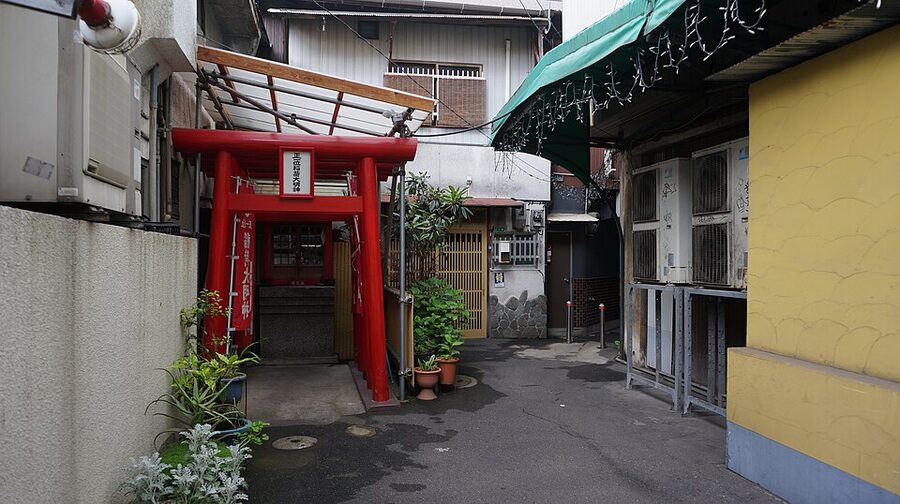
The door tells you what kind of shop it is. A kakuuchi will have:
- A bottled-products noren or a cigarette sign on the entrance.
- A small handwritten board, in pen, listing today’s special bottle (honjitsu no osake, “today’s sake”). This is not a restaurant menu, it’s a single recommendation.
- A glimpse, through the door, of fridges and shelving that occupy 80% of the shop.
- Often, a vertical paper sign with the word 角打ち in calligraphy. If you see this, you’re in the right place. The character 角 (kaku) is the same one used in 角煮 (kakuni, simmered pork) and 三角 (sankaku, triangle). Once you’ve seen it twice you’ll spot it from across a street.
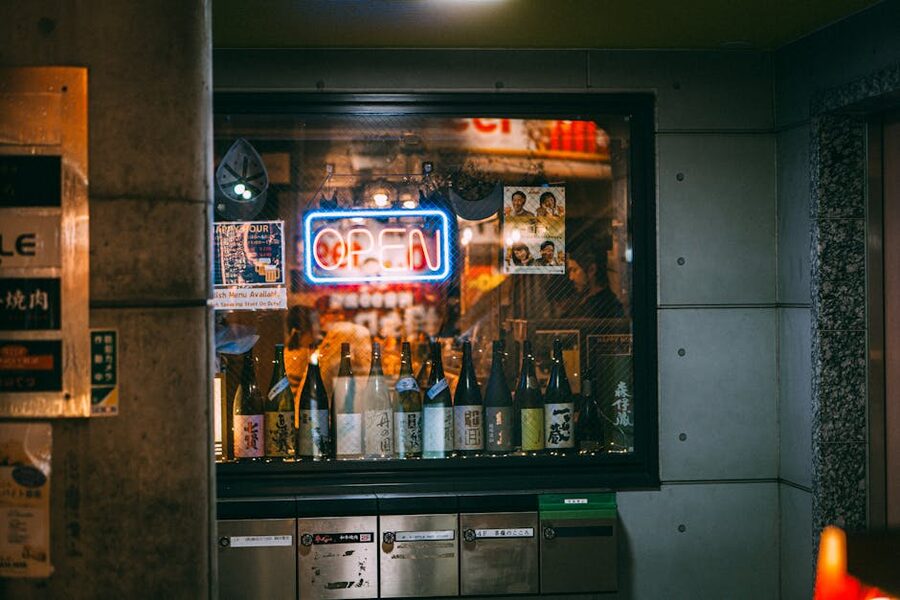
You will not see: a chalkboard menu of grilled chicken in fifteen flavours. You will not see: an “OPEN” flag. You will not see: a host or hostess greeting people in.
Walk in at 17:30, not 21:00
Most kakuuchi run a different schedule from bars. Opening times sit in the 11:00–15:00 range and closing is often as early as 19:30 or 20:00. The window is the late afternoon to early evening. Some shops in Kitakyushu, like the Hayashida Sake Shop near Kokura Station, open in the morning to catch the night-shift drinkers; many start at 15:30 and serve until 21:00 at the latest. Show up too late and you’re standing in front of a closed shutter watching the lights go off in the residential floors above.
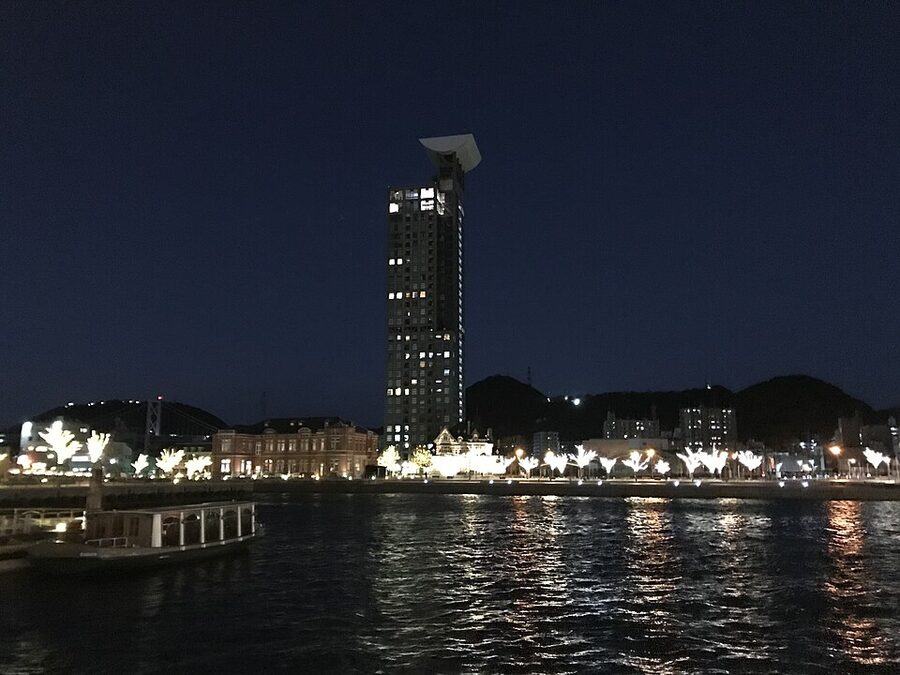

Six named shops to think about
Three in Kitakyushu, two in Fukuoka City, two in Tokyo. None of these can be booked. Some are first-come, all are walk-in. Hours change. Bring this article as a starting point, not as a promise.
Uozumi Saketen, Moji
Founded 1934. A narrow, tunnel-shaped shop with a counter facing wall-mounted shelves of sake and beer, tucked among residential buildings in the Moji district less than 2 km from Sake no Awaya. The interior is what every other kakuuchi is trying to look like: the patina is real. Fifteen-minute walk from JR Mojiko Station; ninety-one years of continuous operation. Cash only. Drinks are self-service from the cooler; the proprietor charges per item. No toilet in the shop; the public restroom is in the small park two blocks west. Mr Uozumi runs it solo since his mother passed; the visit is partly social, partly archaeological. Good if you have a quiet patience for a place where the proprietor remembers the customers his mother served.
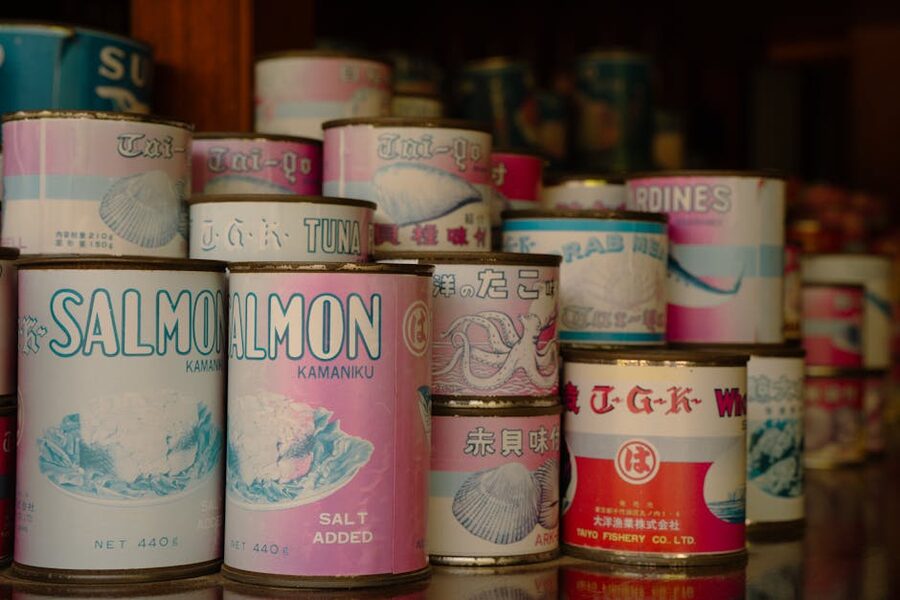
Akakabe Sake Shop (Akabe), Tanga Market, Kokura
Inside the Tanga Market in Kokura, opens at 10:00. Akakabe means “red wall,” supposedly named after a red brick wall in the founder’s birthplace in Hiroshima. After a 2022 fire destroyed parts of the market, the shop relocated to the open-air market site with half its previous floor space. They carry seasonal limited bottles you’ll find nowhere else: Yatagarasu Namazake (the spring unfiltered drop) and Natsuzake (summer-edition sake) from breweries across Japan. The wall is hung with photos of Showa-era celebrities and faded sake-maker posters from the 1970s. Best snack is the local Kokura speciality, nukadaki: mackerel slow-cooked in a fermented rice-bran bed (nukamiso). The flavour is funky, salty, slightly miso-like, and made for cold sake. Cash only. The owner will talk if you start; will not talk if you don’t.
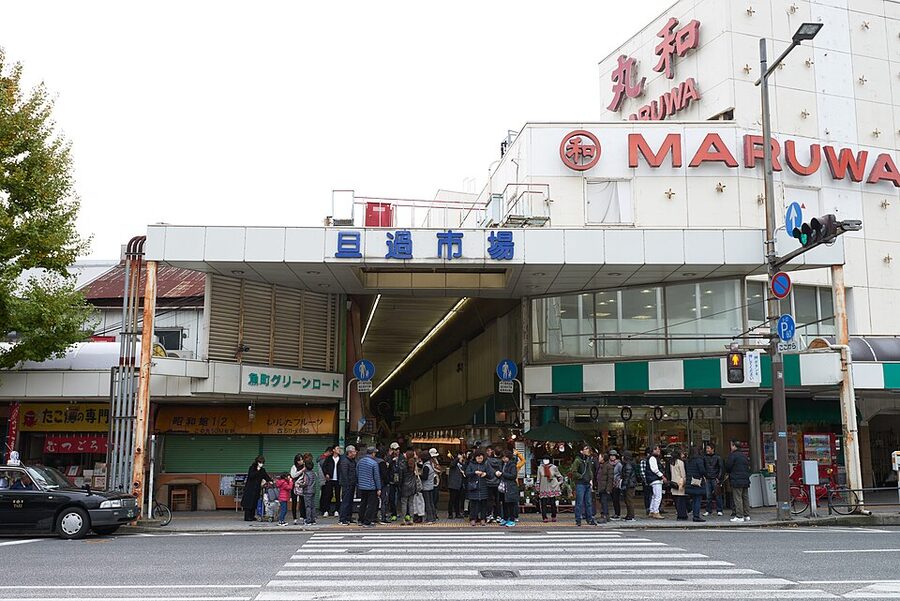
.jpg)
Hayashida Sake Shop, Kokura
Five minutes from Kokura Station and one of the easiest shops to walk into for a first-time kakuuchi visitor. Hayashida is the antenna shop for the Hayashi Ryuhei Sake Brewery (founded 1837) in Miyako-machi, Fukuoka Prefecture. They opened the standing-corner side in 1933. The drink to order is the brewery’s flagship, Zanshin, which translates loosely as “the spirit that remains after the technique.” On the counter sits a tasting map in Japanese and English. You pick three bottles, the proprietor pours them in a flight of ochoko cups, and you compare them side by side. Roughly ¥1,500 for the three-flight. This shop has a small English menu and accepts cards. It’s the gateway kakuuchi.
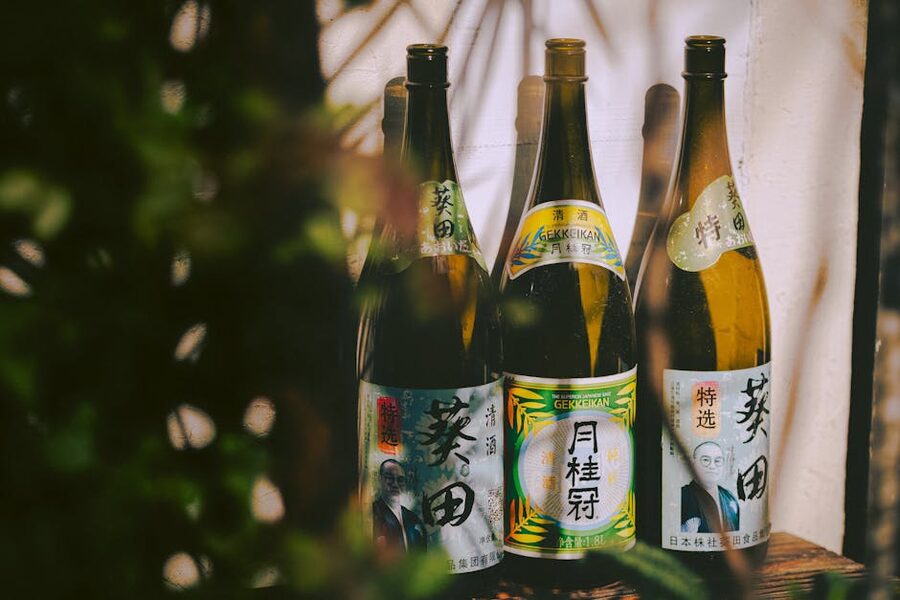
Kotani Saketen, Tenjin-Daimyo, Fukuoka
Founded around 1960, in the centre of the largest entertainment district in Kyushu. Kotani is one of the high-profile kakuuchi that’s been on Japanese morning TV more than once and still feels like a neighbourhood shop, mostly because the regulars treat it like one. The drink range is the unusual part: alongside Japanese sake and shochu, they stock European and American beers and a small Italian-leaning wine list. The food side is more developed than at a stricter Moji-style shop, with light Italian and Japanese small dishes, including a stupidly good oden in winter. Comfortable for first-timers, foreigner-friendly without being touristy. Cash and card.
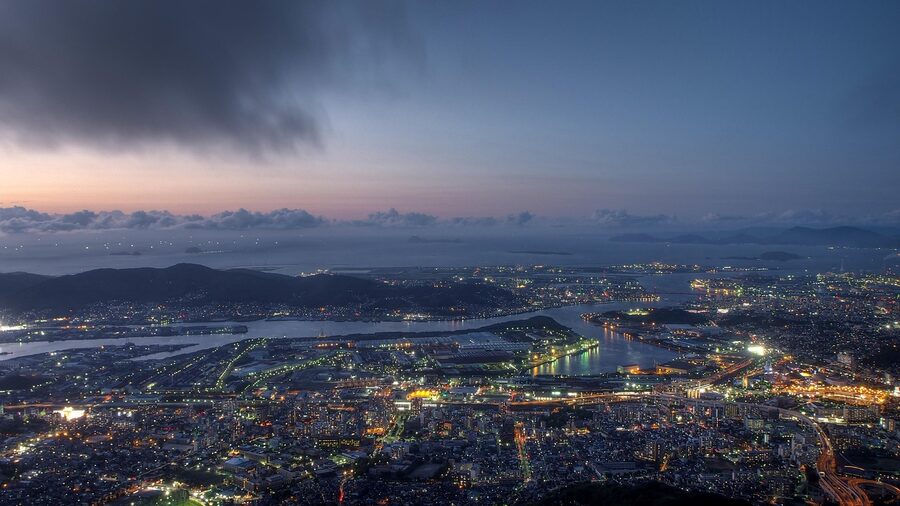
Koba Saketen, Yakuin Mutsukado, Fukuoka
Founded as a liquor store in 1930. The kakuuchi entrance is at the back of the shop, accessed through a more contemporary front. The wall menu lists over forty snacks, far more than typical, including squid dumplings, whale sashimi (only when they have it; mid-summer onwards), and chicken skin in ponzu. The signature dish is a vertical, crispy salt yakisoba that I’ve not seen elsewhere. Wines start at ¥300 a glass and top out around ¥700. Owner-picked bottle list, friendly to English questions, popular enough to need a 17:00 arrival on weekends. The American sake writer Stephen Lyman, co-author of The Complete Guide to Japanese Drinks, calls this his first kakuuchi and recommends it for foreigners on a first visit.
Standing Room Suzuden, Yotsuya, Tokyo
This is the Tokyo answer. Suzuden is a regional sake specialist that’s been operating in Yotsuya for decades, and the standing-corner attached to the retail shop is one of the city’s most loved kakuuchi. The shop holds bottles you can’t find anywhere else in Tokyo, including small Yamagata and Niigata producers, the kind of junmai daiginjō that doesn’t make it into the Tokyo distribution chain. Tastings are by glass, ¥400–1,200 a pour, with the cheaper bottles in the cooler self-serve. Snacks are the basket model: rice crackers, dried squid, peanuts. Standing only. No toilet. Closed Sundays. Three minutes from the Yotsuya Station Akasaka exit.
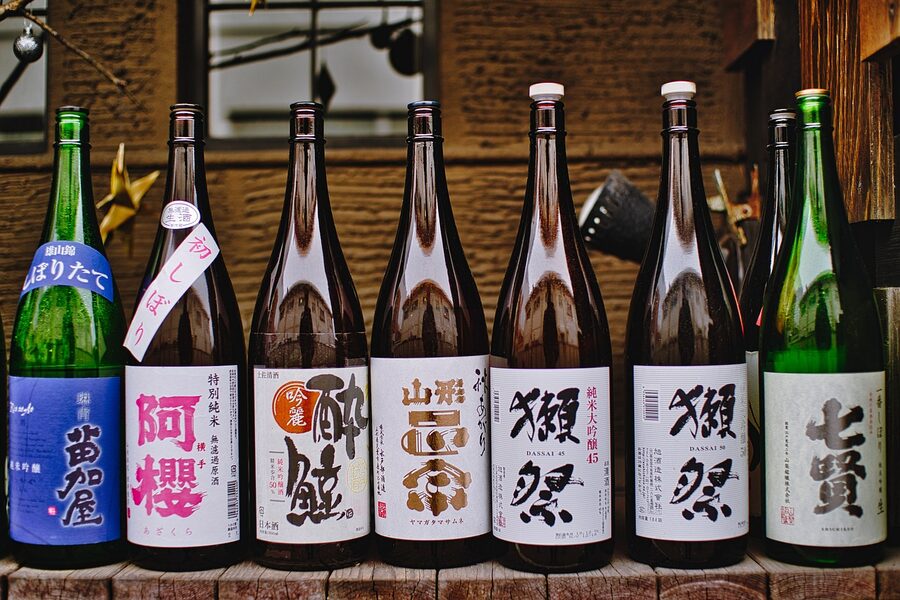
What to drink and what to eat
The drink at a kakuuchi is the bottle that the shop is selling. That sounds obvious. What it means in practice is that the menu changes by the season and by the proprietor’s relationships with breweries. A May visit gets you the nama (unpasteurised) spring drop. A November visit gets you the new-brewing-season shinshu. A January visit gets you shiboritate, fresh from the press, with the carbonation still active. Cold sake dominates summer; hot sake dominates winter. The shop’s blackboard outside or its handwritten paper inside will tell you what’s on this week.
You order one cup at a time. Ippai, “one cup,” is the unit. Don’t ask for a flight unless the shop offers a comparison set (Hayashida does, Kotani does, most Moji-style shops don’t). The pour is usually generous, an ichigō measure (180 ml, the standard Japanese sake unit) for the basic bottles, sometimes a half-gō (90 ml) for the rarer ones.
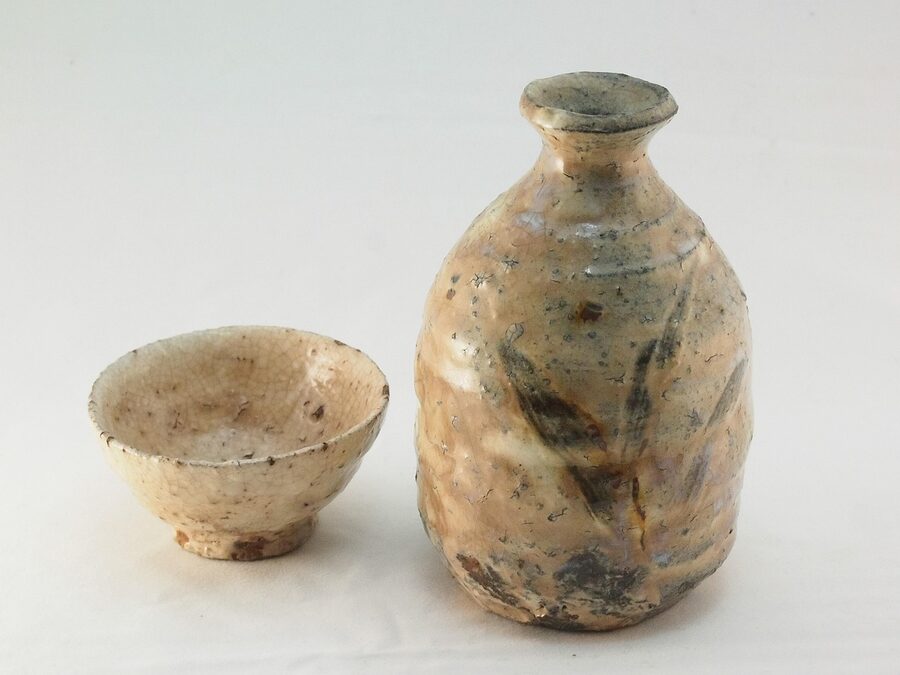
Beyond sake, expect to see shochu (the kakuuchi in Kyushu lean heavily into shochu, with imo sweet potato, mugi barley, sometimes kome rice), the shop’s own nihonshu selection, big-brewer beer (Asahi or Sapporo on tap or in tall bottles), and increasingly Japanese craft beer in cans. Whisky shows up at modern shops that have Highball gear behind the counter. Cocktails are rare but not unheard of; a few Tokyo neo-kakuuchi do simple cocktails in cans or a chu-hi setup.
The senbero set
The local bargain you should know about is senbero: short for sen-en de bero-bero, “drunk for a thousand yen.” It’s a fixed-price drink-and-snack set that puts you somewhere over the line on ¥1,000. Most Kitakyushu shops do a senbero; many Fukuoka shops do; some Tokyo shops do a higher-priced ¥1,500 version. The drink is usually a beer or a sake by the cup, and the snack is two of the basket items (rice crackers + tinned fish is the classic). It’s the cheapest above-board way to get a real drink in central Tokyo.
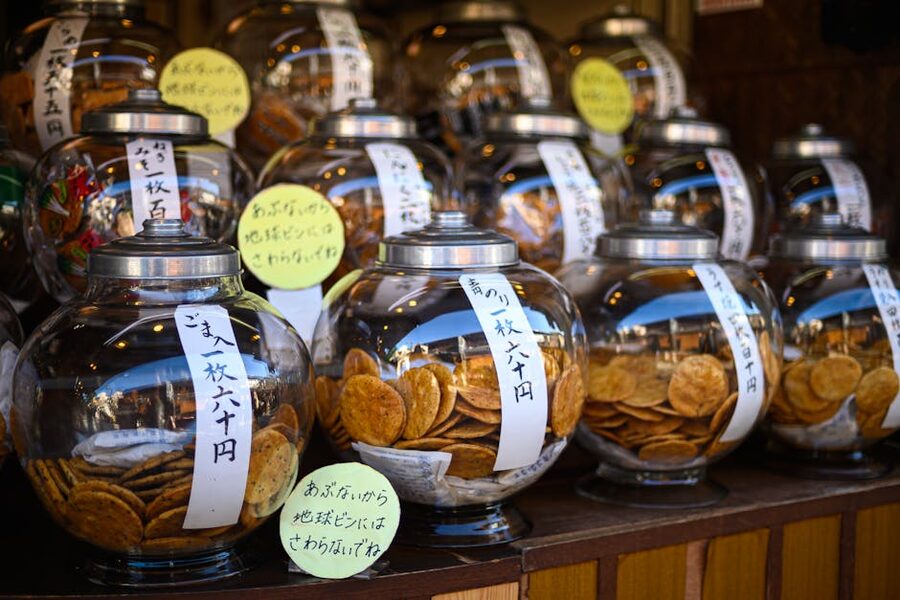
About the food
If you’re hungry, eat first elsewhere. A kakuuchi is not a meal. The snacks are there to slow your absorption, not to feed you. The exceptions are the broader-licence shops: Koba Saketen with the forty-item wall menu, Kotani with the small Italian plates, the few Tokyo neo-kakuuchi that have crossed into “deli” territory like Kuwabara Shoten in Gotanda. At a strict Moji-style shop the most cooked thing you’ll get is a tin of mackerel that the proprietor opens behind the counter and slides over the wood. Don’t be disappointed. Eat a kaiseki dinner after.
The masu, the etymology, and a small drinking detail
Almost no kakuuchi serves sake from a wooden masu any more. Glass ochoko, ceramic guinomi, and increasingly wine-stem sake glasses have replaced the box almost everywhere except souvenir-photo shops. The masu lingers in the etymology and in the imagery on shop signs.
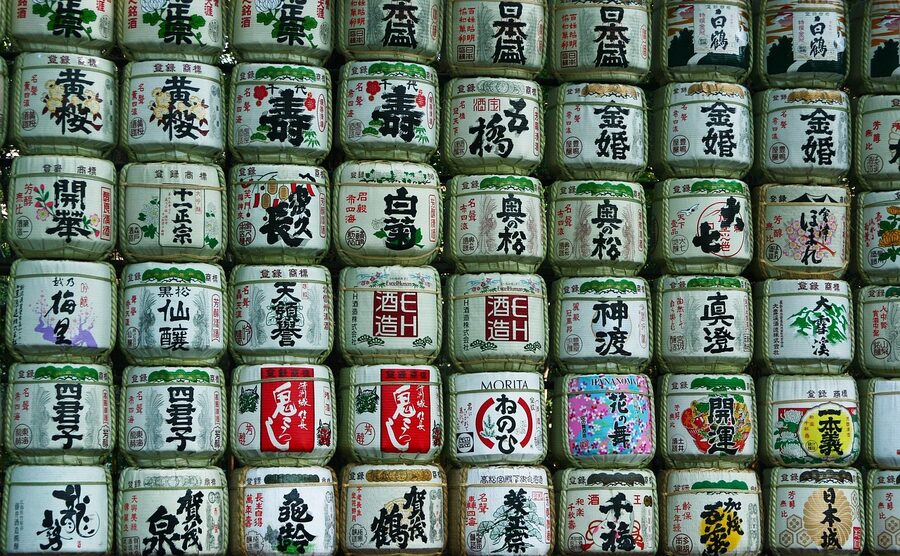
The Edo-era practice that gave the word its first etymology went like this: a sake drinker brought their own bottle to the shop. The shopkeeper measured sake from the barrel using a wooden masu and poured the measured volume into the customer’s bottle. Some drinkers, curious about other bottles on the shelves, asked to taste before they bought. The shopkeeper would pour a small measure into the masu itself and pass it across; the customer would drink straight from the corner of the box. The corner-strike action is the etymology in the kanji.
The Tohoku mokkiri tradition kept the practice with one twist: the masu sits inside a small saucer, and the shopkeeper deliberately overfills, so that the sake spills over from the masu’s edge into the saucer below. The customer drinks the masu first, then drinks the spillover. The implication is generosity beyond what was paid for. If you’re in Niigata or further north, ask if a shop serves mokkiri-style; the answer will mostly be no, but the few that say yes are worth the detour.
The etiquette I now know
This is the section I would have wanted before my Tanakaya visit. None of these are deal-breakers. The Japanese drinkers I’ve met are forgiving of foreigners. But knowing them lifts the visit from “tolerated tourist” to “welcomed guest.”
Cash only, every order
The cash-on-delivery rule is the cultural skeleton of the place. Pay every time. ¥500 coins are king. Carry a stack. Some neo-kakuuchi have drifted to QR-code payment, and Hayashida in Kokura does take cards, but assume cash and you’ll never be wrong.
Don’t sit unless you’re invited
If a kakuuchi has a chair, it’s for the proprietor, the regular who’s been a regular since 1985, or the regular’s elderly mother. There are exceptions (Saito Saketen in Yahata-Higashi has actual stools because the proprietress wanted them) but assume standing. If you’re invited to take a chair, take it. If you’re not, don’t.
Pour for others, not for yourself
The general izakaya rule extends here. If someone hands you the bottle, accept with both hands, pour for them first, and only then for yourself. With strangers in a kakuuchi this happens less often than at an izakaya, since people are mostly drinking from their own bought-by-the-cup glass, but it does happen, especially after the third visit when you start being recognised.
Volume control
The shop is small. A loud foreigner is a louder foreigner. Match the room. If everyone’s at conversational volume, stay there. If the room is quiet, the room is quiet. The standard izakaya cheerful-noise convention does not apply here.
Don’t linger past your second drink
The unwritten rule is two drinks and out. Maybe three. Anything longer and you’ve made yourself a fixture. The space is small, the rotation matters, and the proprietor wants the next person to be able to step in. Set yourself a limit of forty minutes and treat it as a constraint, not a suggestion.
The toilet question
Most kakuuchi have no toilet. This is a real practical issue at a long-running session. The pattern is: go before you go in, or drink a coffee at the konbini next door first. If you absolutely must, ask politely (otearai wa arimasu ka?) and accept “no” gracefully. The walk to the public restroom in a Kitakyushu market square is twenty seconds and it’s part of the experience.
Don’t photograph the regulars
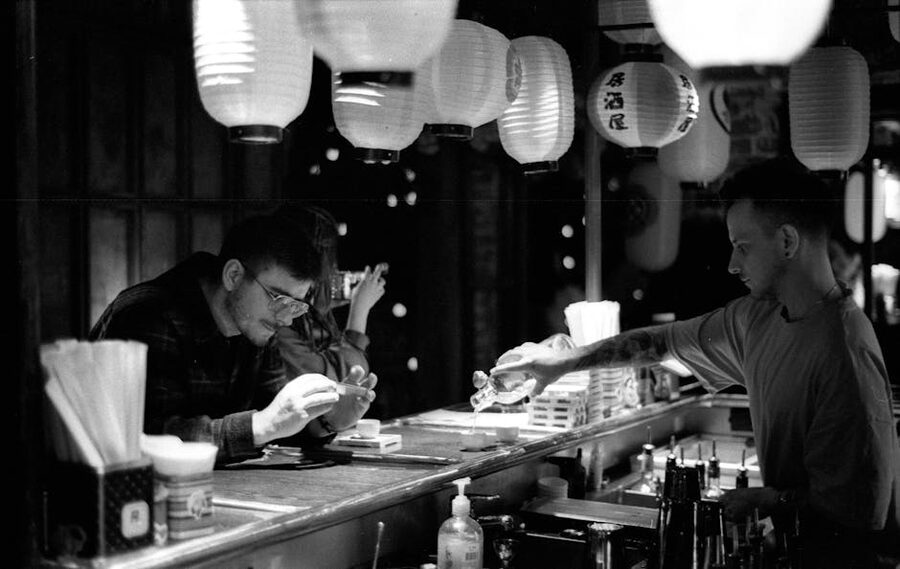
You can photograph the bottles. You can photograph the wall. You cannot photograph the people, and most owners get visibly stressed if you reach for the camera in the direction of their customers. If you really want a portrait, ask. Mostly the answer is no.
The Tokyo revival
Tokyo’s relationship with kakuuchi is unusual. The capital had them in volume in the early 20th century, especially in the working-class east, around Akabane, Asakusa, and Sumida, but the practice contracted sharply in the late 1990s and early 2000s when food-hygiene regulations were tightened, and any liquor store that wanted to serve food had to also register as a restaurant. Many shut the standing-corner rather than register.
The recent revival is a deliberate one. Akiyasu Seki, who runs the Tokyo kakuuchi Futaba and chairs the youth branch of the Tokyo Liquor Retailers Association, has been pushing the thing in two directions. The first is a visible-event strategy: the Liquor Store Kaku-uchi Festival, launched in 2018 by his organisation (which represents 2,300 Tokyo liquor shops), runs twice a year. Dozens of the city’s liquor stores set up stalls in a public space; people taste sake, eat festival food, and listen to live music. The most recent edition drew 30,000 attendees. The second strategy is preservation by adaptation: encourage existing liquor stores to convert a corner of the shop into a kakuuchi as a survival mechanism, since basic alcohol retail is being eaten by konbini and supermarkets.
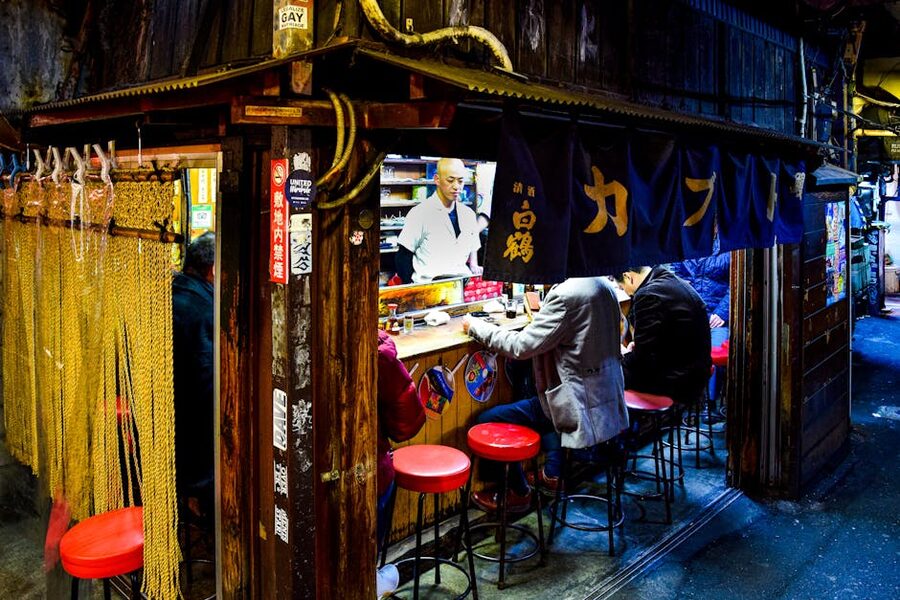
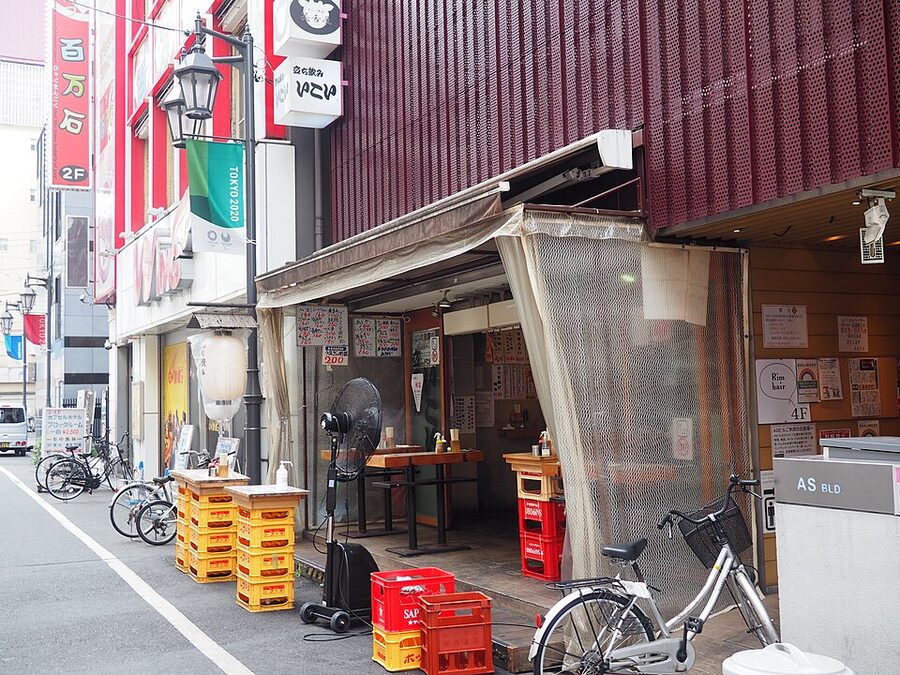
What you’ll find in modern Tokyo is therefore two distinct things side by side. The traditional kakuuchi, like Suzuden in Yotsuya or the older shops in Akabane, where the etiquette I described above applies cleanly. And the neo-kakuuchi: shops like Kuwabara Shoten in Gotanda, where the interior has been polished, the lighting redesigned, the food turned into deli plates of small craft cheeses and prosciutto, and English menus are printed. Both are legitimate; the latter is easier for first-time visitors; the former is what you went to Japan for.

The gender shift
For most of the 20th century, kakuuchi were men. The clientele was the steel-shift workforce, then the post-war salaryman returning home, then the long-term regulars whose wives weren’t invited and didn’t want to be. Women drinkers I’ve talked to in Kitakyushu, including members of the Kaku-uchi Culture Study Group, talk about being told twenty years ago that the places weren’t for them. One office worker, Tomoko Ikemoto, said her male colleagues refused to take her in the early 2000s because they considered the shops men-only.
That’s largely past. Modern kakuuchi are mixed. Female customers are common, female proprietors are visible (Saito Saketen in Yahata-Higashi has run on a proprietress’s authority for decades), and the new-wave neo-kakuuchi are explicitly aimed at women drinkers as well as men. The change tracked the broader Japanese workplace rebalancing, since office-worker drinking is no longer all-male in any city, but the kakuuchi shift was slower and is more recent. If you’re a woman walking into a small Moji shop alone in 2026, you might still be the only one. Nobody minds. Some proprietors light up with a small kindness because it’s still novel enough to register.
Where kakuuchi fits in a Japan trip
It fits as the late-afternoon detour, not as the dinner plan. A typical day:
- Morning: museum, walk, market.
- 14:00–15:00: lunch at a soba shop or a kissaten.
- 16:30: into a kakuuchi for one cup of sake and a tin of mackerel.
- 17:30: out of the kakuuchi.
- 19:00: izakaya for dinner proper.
- 21:30: a single nightcap at a quieter Tokyo whisky bar if you have the energy.
Treating the kakuuchi as the small, focused, fast event that it is, rather than as the centrepiece of an evening, is the way the locals do it. A kakuuchi is half-an-hour, not a night out. The compressed brevity is the point. You’re getting a cross-section of a working town’s drinking life in twenty minutes; if you stretch it to two hours you’re misunderstanding it the same way I misunderstood it when I sat down.
Three regional kakuuchi trips worth planning
If kakuuchi is going to be the spine of a trip, here are the three routes.
Kitakyushu, two nights
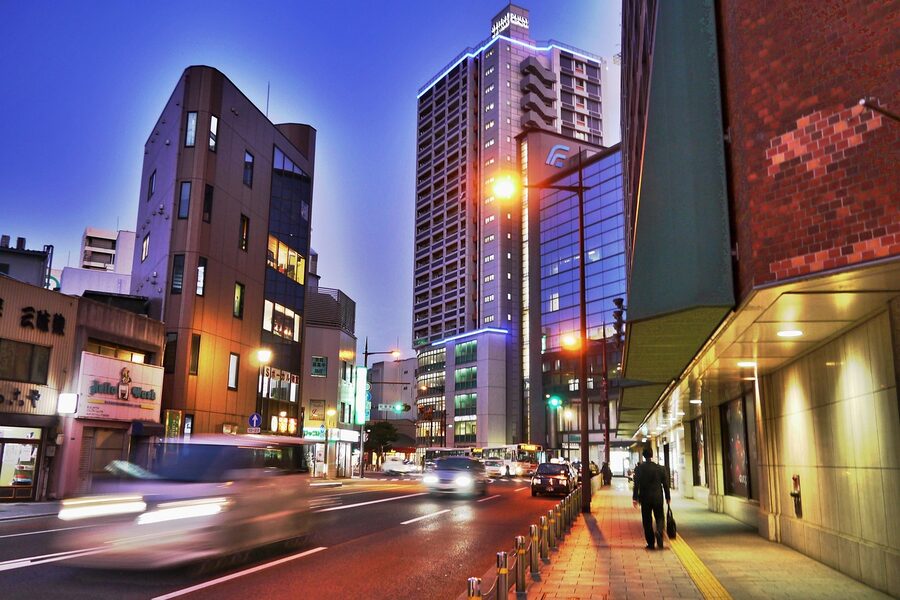
Fly into Fukuoka, take the Sanyo Shinkansen one stop to Kokura (16 minutes from Hakata, 13 minutes from Fukuoka Airport via the subway). Stay near Kokura Station. Day one: Tanga Market in the morning for breakfast, Kokura Castle in the afternoon, Akakabe at 17:00 for the relocated open-air kakuuchi, then Hayashida for the three-flight Zanshin tasting at 19:00. Day two: train to Mojiko (15 minutes), Mojiko Retro in the morning, Uozumi Saketen at 16:30 for the long-running shop. Then back to Kokura on the local line and a final cup at Tanakaya near Kyomachi. Two nights, three to four kakuuchi. The most concentrated kakuuchi territory in Japan.
Fukuoka City weekender
Fly direct to Fukuoka. Stay in Tenjin or near Hakata Station. One night for Kotani Saketen in Tenjin-Daimyo for the Italian-leaning hybrid kakuuchi, the next night for Koba Saketen in Yakuin Mutsukado for the forty-item snack wall. Add a Hakata yatai food-stall dinner between the two and you’ve got a textbook Fukuoka eat-and-drink weekend. Combines well with my notes on Fukuoka generally.
Tokyo half-day
Pick up the Yotsuya stretch. Suzuden first, around 17:00. Then walk fifteen minutes to Yotsuya Sanchome and a second sake retailer that does a smaller corner. Then either pivot to a Shinjuku sake bar for a full sit-down, or take the Marunouchi line to Otemachi, the Tozai line to Kiba, and walk to the smaller Akabane standing district. The half-day version is the introduction; for the deeper Tokyo version, see my Tokyo bars guide.
What kakuuchi gets you that an izakaya doesn’t
An izakaya is a designed experience. The owner picked the menu, the proprietor sequenced the dishes, the room is built to keep you for two hours. A kakuuchi is unedited by definition. The bottles on the shelves are what the wholesaler delivered. The food in the basket is what the proprietor was in the mood to put out. The patrons are whoever happened to be walking past. The hour-long stop is the difference between watching a Japanese drinking culture and being briefly inside it.
The other thing, and this one is harder to articulate, is that a kakuuchi is the most economically straightforward place to drink in Japan. The bottle costs you what it costs the shop plus a small standing-fee. There is no service charge, no otōshi compulsory amuse-bouche, no rounds of tip. A 720 ml bottle of a regional junmai retails for ¥1,800; the same bottle is poured at a kakuuchi at maybe ¥600 a glass, three glasses to a bottle. At an izakaya it’d be ¥1,200 a glass with the same pour. Drinking cheap in Japan almost always begins with a kakuuchi.
.jpg)
Going home
I went back to Tanakaya six months after my first failed visit. I knew what to do. I bought a small bottle from the cooler, paid in coins, took a packet of dried cuttlefish from the basket, paid again, and stood in the spot the proprietor pointed me to last time. I drank one cup. I told him in my poor Japanese that the unfiltered bottle from the local Niigata brewery was good. He nodded, a small movement, and turned back to the customer behind me. I drank a second cup. I left at 35 minutes.
That visit didn’t make a memory the way the first one did, because the second one wasn’t a story. It was a Wednesday-evening drink. Which is what kakuuchi were always meant to be.
 Drinking CultureWhy I Stopped Clinking Glasses in JapanThe first time I got a Japanese toast wrong, I was at a wedding reception in Yokohama. Ten of us…
 Drinking CultureKonbini Drinks Are a Whole Trip StrategyJapan has roughly 56,000 convenience stores. That's more outlets than McDonald's has worldwide, and the country sells about a third…
 Drinking CultureOtoso, Bonenkai, and the Hush of ShogatsuThe first person to write the recipe for otoso was a third-century Chinese physician named Hua Tuo, and he wrote…