
The first person to write the recipe for otoso was a third-century Chinese physician named Hua Tuo, and he wrote it for a man who probably did not deserve it.
Hua Tuo was the personal doctor to Cao Cao, the warlord whose name still echoes through every Three Kingdoms novel and video game in East Asia. Cao Cao drank too much, slept too little, and ran a state on edge. So Hua Tuo built him a medicinal sake: a bag of eight herbs, steeped in rice wine for several hours, drunk first thing on the first morning of the year. The name he gave it has held its shape for eighteen hundred years. The first character, tō, means to slaughter. The second, so, means to revive. Slaughter the demon, wake the spirit. Otoso.

The recipe travelled. By the early ninth century, the Saga Emperor had brought it into the Heian court at Kyoto, and from there it spread, slowly, into the doctor’s bag and the merchant’s home and finally the everyday Japanese New Year. The eight herbs became seven, sometimes ten. Aconite root, far too poisonous to drink, was quietly dropped. The peach tree the herbs once hung from is gone. The kasu hung at the gate to ward off illness for the year is gone. But the cup is still there. Three of them, actually. And if you happen to be in Japan from the last week of December through the first week of January, you will see them on a kitchen counter somewhere, and you will probably miss the entire ritual unless someone walks you through it.
This is that walk-through. Otoso is the centre of it. But the New Year drinking culture that holds otoso has more parts than most travellers realise: the bonenkai blowouts at the end of December, the late toshikoshi soba on the 31st, the otoso ritual at dawn on the 1st, the omiki sip at the shrine, the taru-zake at the company shinnenkai a week later, the mallet split of the kagami-biraki cask in mid-January. I’ll go through each, and I’ll be straight about which ones you can experience as a visitor and which ones you mostly cannot.
In This Article
- What you actually drink across the Japanese New Year
- Bonenkai: how Japan ends the year, drunk
- What changes at the bar after Christmas
- The 31st: toshikoshi soba and one quiet drink
- The morning of 1 January: otoso, properly done
- The tosoki: the vessel set you will only see at New Year
- The order: youngest first, oldest last
- What you say while drinking
- What the herbs actually are
- Sake or mirin?
- What otoso actually tastes like
- The regional variations: where otoso goes off-script
- Otoso with osechi: the meal it joins
- Hatsumode and omiki: the shrine sake of the new year
- What omiki actually is
- Etiquette in 90 seconds
- Where to do hatsumode for the omiki specifically
- The shogatsu hush: drinking from 2 to 5 January
- Shinnenkai and taru-zake: the second wind, mid-January
- The brewery brands worth knowing
- Kagami-biraki: the cask split, around 11 January
- Where to attend one as a visitor
- Where you can taste otoso as a traveller
- Sake bars in Tokyo
- Department-store basement liquor counters
- Hotel restaurants
- The Ritz-Carlton Tokyo Martini and the modern angle
- The unromantic side: drinking and the Japanese New Year crash
- How to bring otoso home
- The longer arc
What you actually drink across the Japanese New Year
Compress the whole arc and it looks like this:
| When | What | Where | What it actually is |
|---|---|---|---|
| Late November to 30 December | Bonenkai sake, beer, shochu, highballs | Izakaya, restaurants, conference rooms | Year-end “forget the year” parties. Loud, drunk, work-adjacent. |
| 31 December, late evening | Whatever you have, with toshikoshi soba | Home, sometimes a soba shop | A quiet last drink with the year-crossing buckwheat noodle. |
| 1 January, morning | Otoso | Home | Spiced sake or mirin, drunk in three sips from three cups, youngest first. |
| 1–3 January, daytime | Omiki | The shrine where you do hatsumode | A few millilitres of consecrated sake, free, in a shallow paper cup. |
| Early to mid-January | Taru-zake | Shinnenkai banquets at companies, restaurants, halls | Cedar-cask sake, served from a wooden box with a pinch of salt. |
| 11 January (or near) | Kagami-biraki sake | Dojo, company hall, sometimes a bar | The opening of a sake cask with a wooden mallet. Communal pour. |
The whole sequence runs for roughly six weeks. Most travellers walk through the busy end of it (bonenkai season, with December crowding) and the empty middle (the three-day shogatsu shutdown when half the country is closed) without realising either is part of the same calendar.
Bonenkai: how Japan ends the year, drunk
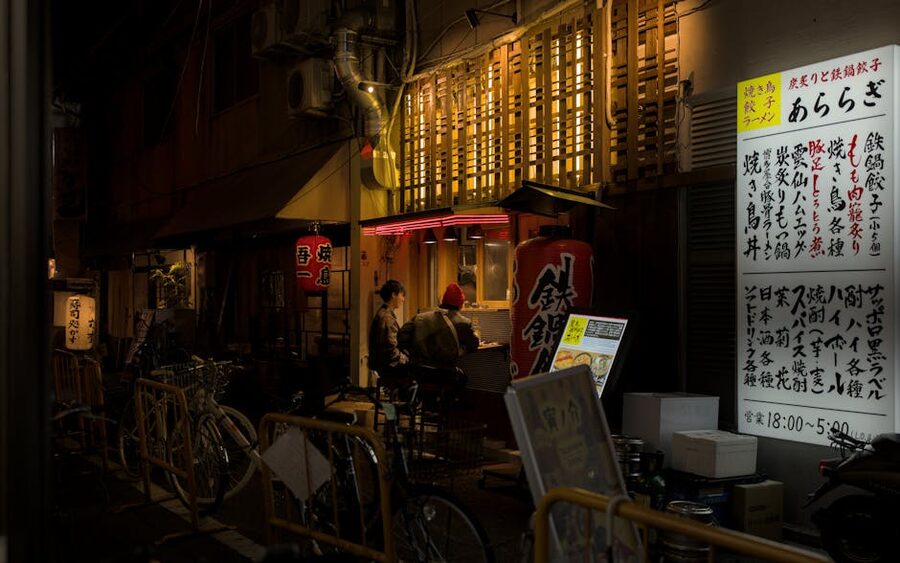
Bonenkai literally translates to “forget the year gathering.” The tradition is older than it sounds: the upper classes were holding gatherings of this shape from the Muromachi period, the 15th and 16th centuries, when samurai households would clear the old year’s slate before the new one started. The general public did not get fully involved until the late 19th century. Now it is so embedded in working life that some companies have multiple. Department-level. Team-level. Sometimes one for the whole company, held in a hall.
If you are travelling in Tokyo, Osaka, Kyoto, or any city large enough to have a salaryman population, you will see them. Mid-December onwards. Big group bookings filling izakayas at 19:00 for a 17:00 start, ties off by 19:30, the second-bar route afterwards. Nijikai, the second party, often at a karaoke box. Sanjikai, the third party, is when only the determined are still standing.
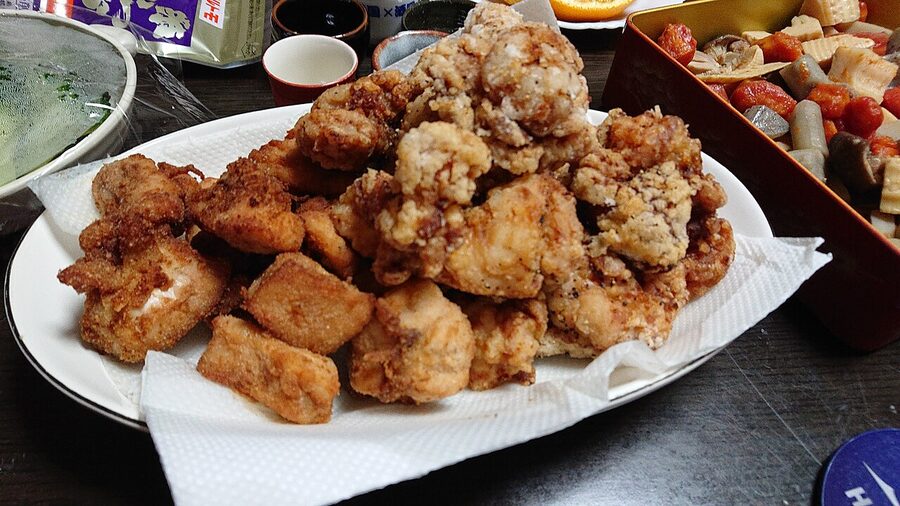
The drink choice at a bonenkai is rarely sake. It’s beer in a tall glass for the toast, then the table goes mixed: highballs, shochu cut with hot water (oyu-wari) or oolong tea, the occasional sake-flask. The all-you-can-drink (nomihōdai) format is built for this kind of evening, and the per-head price is one of the better arguments for drinking in Japan on a budget. The food is izakaya standard, the kind of menu I covered in the izakaya ordering guide: yakitori, fried chicken (karaage), sashimi platters, the inevitable potato salad. Highballs dominate because they are cheap on nomihōdai all-you-can-drink courses, and they pair with everything on the table.
For a traveller, the bonenkai season has two practical effects. One: from about 10 December to 30 December, the better izakayas in Tokyo, Osaka, and Kyoto are very hard to walk into. They are pre-booked for big groups. Sometimes a sign says kashikiri, “private booking, closed to walk-ins.” If you want to try a specific izakaya during this stretch, book ahead by phone or via the restaurant’s site. Two: the bonenkai energy is real and worth experiencing. If your hotel staff offer to introduce you to a small place that takes solo diners, take it. The atmosphere of a Japanese office team unwinding properly in mid-December, six rounds in, is something you do not get the rest of the year.
What changes at the bar after Christmas
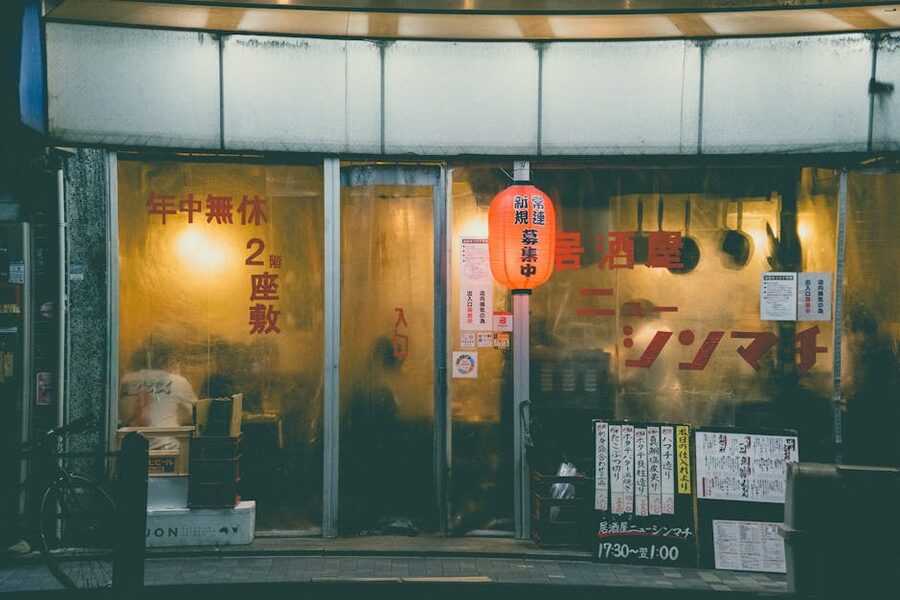
Christmas is not a public holiday in Japan, so the corporate parties continue right through 25 December. What does shift is the music in the bigger izakaya chains: faintly seasonal jingles, the occasional Mariah Carey track, a tinsel string above the doorway. By 27 or 28 December the chains slow down, the small independents do their last big nights, and the city quietens into the four-day shogatsu lull. Many independent izakayas close from 30 December through 3 or 4 January. The chains stay open with shorter hours.
The 31st: toshikoshi soba and one quiet drink
IMG_20211231_212751.jpg)
If you are at a Japanese household on the night of 31 December, the rhythm of the evening is quiet. The big drinking is behind you, in the bonenkai weeks. The big drinking ahead is the otoso the next morning. The 31st is in between.
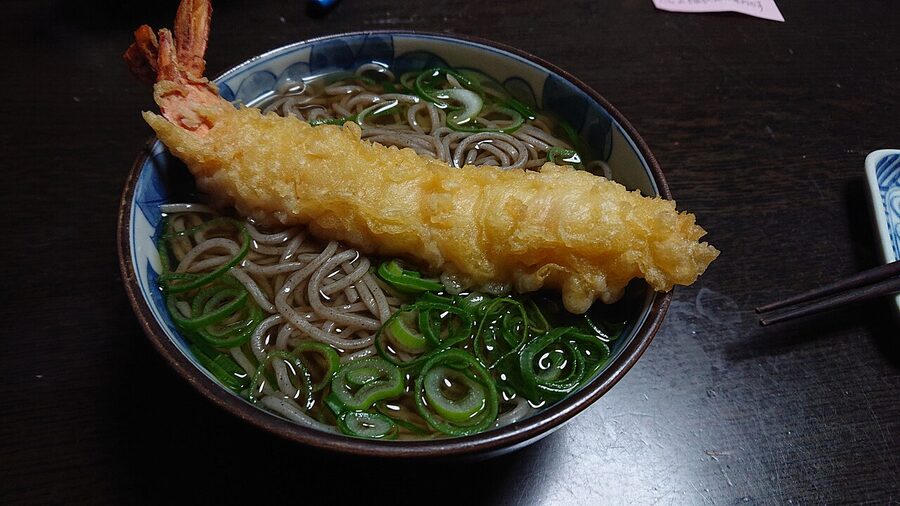
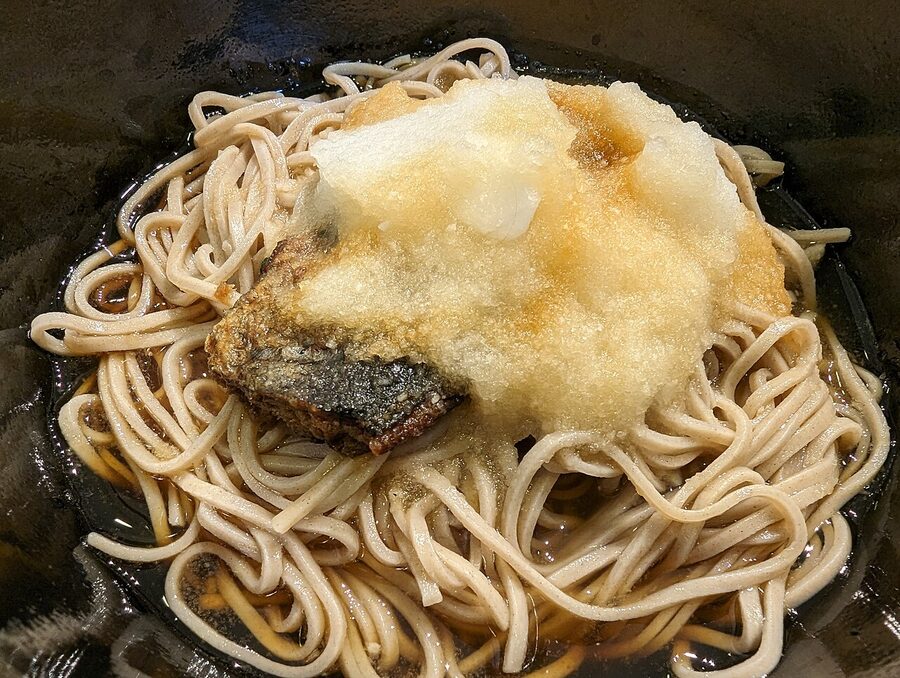
Households watch Kōhaku Uta Gassen, the year-end song competition, on NHK from 19:30 to about 23:45. Sometime between dinner and midnight, somebody puts a kettle on and serves toshikoshi soba, “year-crossing soba.” It is a bowl of buckwheat noodles in dashi, often with a piece of tempura on top. The reason for the tradition has several explanations and you will hear all of them: long thin noodles for long thin life, easy-to-cut soba dough for cutting away the year’s bad luck, buckwheat plant resilience standing for human resilience. Whatever the explanation, the bowl is light, and so is the drink that goes with it.
Most families pour cold sake or warm sake at this point, depending on weather. There is no formal name for this drink, and no ritual. It is just the last sake of the year, drunk slowly while the temple bell on TV starts to ring 108 times for the 108 sins of Buddhist tradition. If the kettle is already on for the soba dashi, the sake of choice is often atsukan, gently warmed in a tokkuri standing in a saucepan of just-boiled water. If you are in Japan and want to try this on your own, the best route is a small independent soba shop that stays open on the 31st. They are a minority. You can usually find one in central Tokyo (Asakusa has a few) or in Kyoto’s older neighbourhoods. The soba is served from late afternoon. Order it with a tokkuri of warm sake and watch the staff dim the lights at 23:00 to begin closing.
The morning of 1 January: otoso, properly done
Drink-wise, the 1st is the centrepiece. And the centrepiece of the 1st is otoso.
If you are in a Japanese household on New Year’s Day, the morning starts early. People rise at first light, or earlier. The kitchen is already prepared. The toshigami, the god of the year, is believed to have entered the home overnight, so the family bows toward the household altar before the cooking begins. Wakamizu, “young water,” is drawn first thing: literally the first water of the year, scooped from a tap or in older homes from the well, used to rinse hands and face. Then the family sits around the breakfast table and the otoso is served before the first bite of food.

The tosoki: the vessel set you will only see at New Year
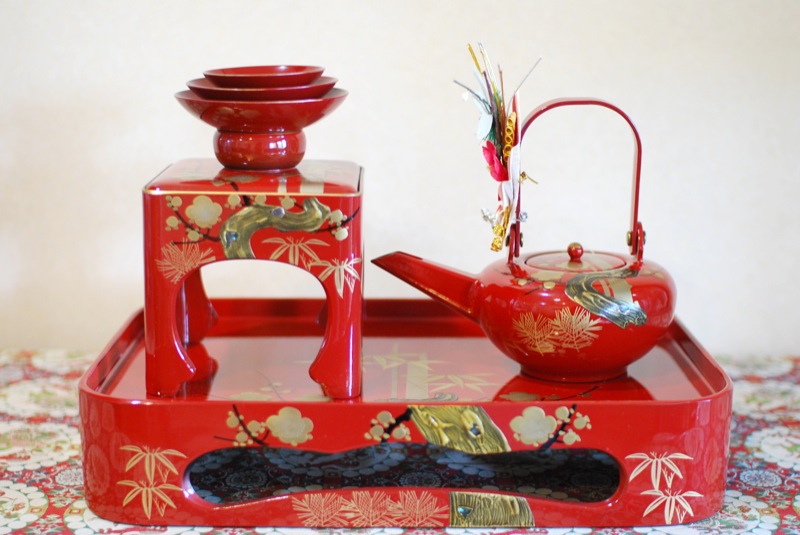
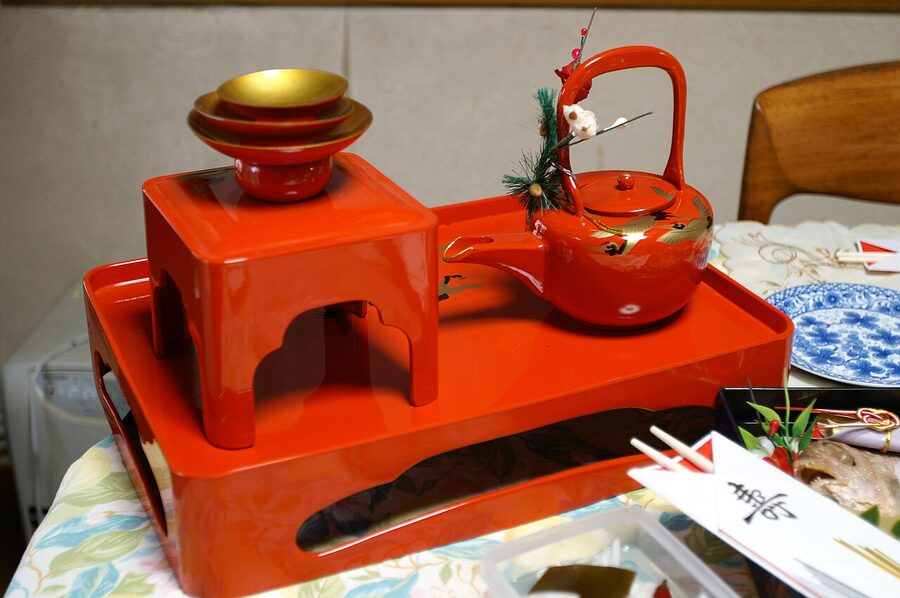
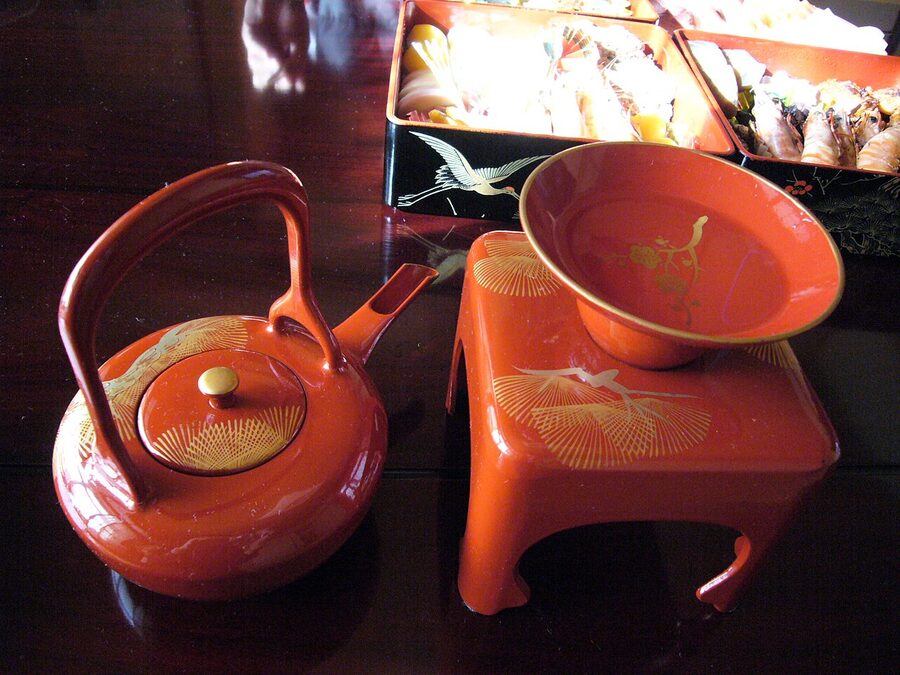
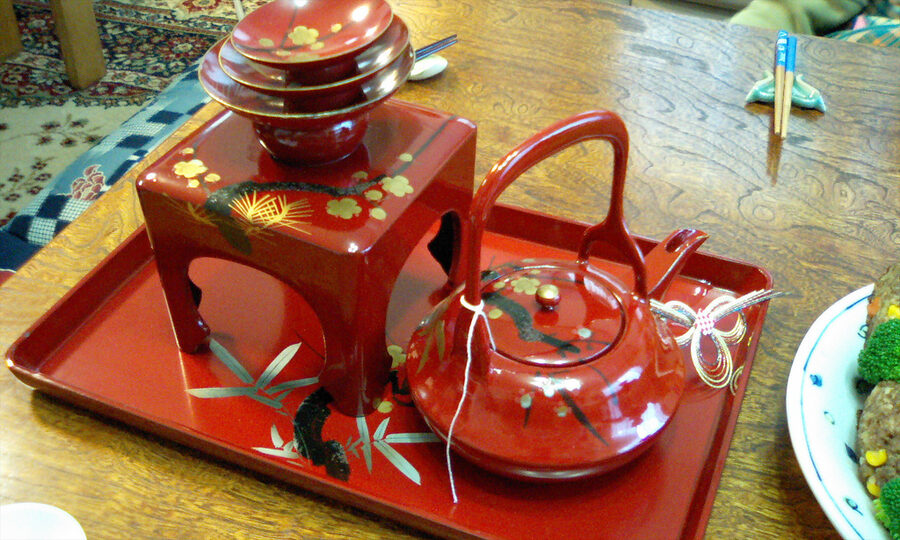
The serving set is called a tosoki. It is one of the few pieces of Japanese drinkware you might use only once a year. The full set has five components: the stand (tosodai) that holds everything, the cup tray (sakazuki-dai), the three nesting cups (sakazuki) sized small to large, the teapot-shaped pourer (chōshi) that holds the otoso, and a small folded ribbon of red and white mizuhiki paper that decorates the chōshi. Three lacquer finishes are traditional: vermilion (shu-nuri, the most formal and most common), black (kuro-nuri), and a brown-tinged transparent finish (tame-nuri) that lets the wood grain show through.
You will rarely see a tosoki in everyday Japanese homes outside of the New Year week. Many households now use a single cup or a regular sake set as a stand-in. The proper tosoki, when it appears, comes out of a paulownia wood box that has been sitting on the high shelf of a closet for the other 51 weeks of the year.

The order: youngest first, oldest last
This is the part most travellers find counterintuitive. Drinking order at a Japanese sake table normally moves from senior to junior. Otoso reverses it. The youngest member of the family drinks first, and the eldest drinks last. The reasoning, as a Kyoto sake brewer’s grandson recalled in a Gekkeikan oral history of his 1936 family New Year, was: “The young are gaining a year, so they drink first to celebrate it. The old are losing one, so they drink last.” The youth’s vitality is meant to pass back through the cup to the eldest.
Some regions invert it. In parts of the country, the head of the household drinks first, on the principle that the elder’s wisdom should be passed down. Households where someone is in their yakudoshi, the unlucky year (typically 33 for women, 42 for men), often have that person drink last so the family’s protective force flows toward them. There is no single “correct” order. There is the order your particular family has always done.
Whoever drinks, the formula is the same. Three cups, sized small, medium, large. Each cup is filled with otoso. The drinker bows once toward the eastern direction (the rising sun, the new year) and drinks the cup in three sips. Then the cup passes along the line, in order. When the smallest cup has gone all the way around, it returns to the top, and the medium starts. Then the largest. Three cups, three rounds, three sips each. Nine sips total per person if you do it strictly.

What you say while drinking
The traditional incantation, said before the first sip or recited mentally, is: Hitori kore o nomeba ikka kurushimi naku, ikka kore o nomeba ichiri yamai nashi. “If one person drinks this, the family will not suffer; if the family drinks this, no one in the village will fall ill.” It is the kind of phrase that sounds heavier in classical Japanese than in English. Most modern households omit it. The Kyoto family I read about kept it.
Children are included. The Minor Drinking Prohibition Act classifies otoso as a separate category of liquor for ritual purposes, so children traditionally take a sip too, though most modern parents either pour the otoso into mirin (sweeter, much less alcoholic) for the kids or have them tip the cup to their lips without drinking. A 1936 Kyoto household memoir describes the eight-year-old going first with a child’s portion of mirin-based otoso, then the four-year-old, then the older sister, then mother, then father, then the seventy-year-old grandfather last. The exact sequence, in a single household, holding for almost a century.
What the herbs actually are
The package you buy in a Japanese pharmacy or supermarket from late December is called tososan, the herb mixture for otoso. By the early 2000s, pharmacies had stopped giving it out free as a year-end customer gift, but the tea-bag form is still sold in supermarkets and drugstores everywhere from late December for around ¥200–500 per package.
The standard Japanese tososan now contains five to seven herbs, depending on the maker. Common components, all originating in Chinese kampō medicine:
- Sanshō (Japanese pepper). The same pepper that goes on grilled eel. Warms the stomach.
- Chinpi (dried tangerine peel). For digestion and as a mild expectorant.
- Keihi or nikkei (cinnamon bark). For circulation; the dominant aroma when you open the bag.
- Kikyō (bellflower root). Anti-inflammatory.
- Hakkaku (star anise). Antibacterial; gives the brew its faintly liquorice undertone.
- Byakujutsu (white atractylodes). For the gut.
- Bōfū (Japanese coastal angelica). The historical anti-cold ingredient.
The 6th-century Sui dynasty original is recorded as eight herbs: sanshō, rhubarb, bellflower, cinnamon-heart, coastal angelica, atractylodes, knotweed, and aconite root. The aconite, monkshood, was poisonous and got dropped centuries ago. Knotweed and cinnamon-heart faded out for taste reasons. The current tososan is a streamlined version, but if you compare a contemporary tea bag with the eighth-century recipe, six of the seven plants are still on the list.
Sake or mirin?
Both. The right base is whichever your household uses, and Japanese families divide on it.
Sake-base otoso is drier, more medicinal, slightly bitter, with the herbs reading more sharply. Mirin-base is sweeter, gentler, and closer to a herbal liqueur than to sake. The classical aristocratic recipe used mirin (mirin was a drinking spirit before it became a cooking ingredient), so a mirin base is the historically older form. A 50/50 sake-mirin blend is increasingly the modern compromise.
Buy hon-mirin, “true mirin,” not the mirin-fū cooking version that contains added salt and would ruin the drink. Hon-mirin is sold next to the regular sake in better supermarkets and in liquor shops; price is roughly ¥800–1,500 for a 500ml bottle. The ratio is one tososan tea bag to 300ml of sake, mirin, or sake-mirin blend, steeped for five to eight hours. Steep too long (over 12 hours) and the brew turns sediment-cloudy and bitter; steep too short (under three hours) and it tastes like sake with a vague spice rinse. Five hours is a clean middle.

What otoso actually tastes like
I’ll be plain. Otoso is not a great drink. It is a ritual drink. The aroma, when you open a freshly steeped chōshi, is dominantly cinnamon and star anise, with a sharp bottom note of sanshō and a vegetal edge from the bellflower and atractylodes. The flavour reminds me of a dialled-down chai with a tannic finish. If you have ever drunk a Chinese herbal medicine tea and thought “this would be slightly less awful with sake in it,” you have an accurate mental model of otoso.
Some households make it palatable with the mirin trick. Some lean the other way and use a clean junmai, accepting the medicinal hit because the ritual matters more than the drink. Both are valid choices. What is not valid is treating otoso the way you would treat a good cold junmai daiginjō: judging it on flavour alone. Otoso is closer to communion wine in spirit. The point is the cup, the order, the family, the prayer for health. The taste is a side effect.
If you want to taste it as a traveller, the easiest way is to walk into a slightly older-style sake bar in Tokyo, Osaka, or Kyoto in early January and ask if they have otoso on. Many do, for the first week of the year, in small portions. About ¥500–800 for a single tasting cup. By the second week of January, almost all of them have moved on.
The regional variations: where otoso goes off-script
Otoso is strongly associated with the Kansai region. The custom spread out from the Kyoto imperial court, so the western half of Japan kept it longer and more formally than the eastern half. Travel north of the old capital, and the tradition gets thinner. In parts of Tōhoku and across most of the Kantō plain, what families drink on the morning of 1 January is plain sake, often warm, called otoso colloquially even though no herbs are involved.
The genuine regional outliers are in Kyushu. Kumamoto’s akazake is a reddish brewed beverage that uses wood ash in the fermentation process to halt the yeast and preserve the sweetness. Kagoshima has kurozake, “black sake,” made by a similar method. Both belong to a category called akumochi-zake (“ash-pressed sake”), and in Kumamoto and parts of Kagoshima, the New Year’s otoso is made with akazake or kurozake as the base instead of regular sake or mirin. The result is sweeter, denser, almost like a slightly fermented dessert wine, and noticeably more pleasant than the sake version.
If you happen to be in Fukuoka or anywhere in northern Kyushu in early January, the akazake-based otoso is the regional answer to “is there a version of this I’d actually want a second glass of?” The answer is yes. Try it. Specialty shops in Kumamoto City near Sakuranobaba Jōsaien sell akazake year-round at about ¥1,000–2,000 a bottle.
Otoso with osechi: the meal it joins
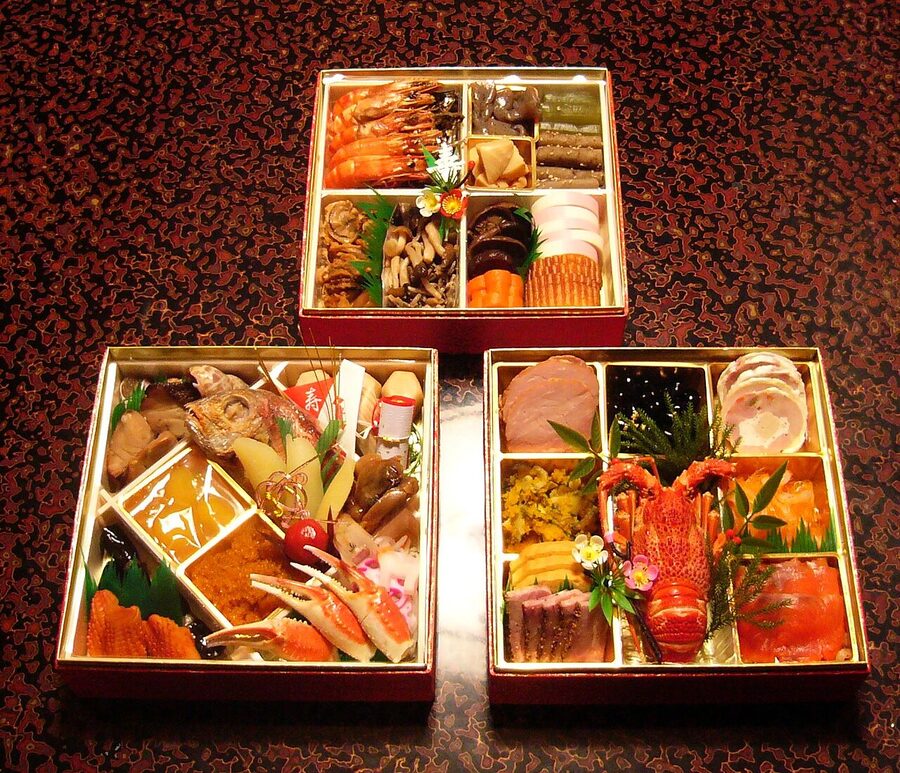
Otoso is drunk before the first food of the day. After the cups have gone around, the household sits down to osechi ryōri: a stacked lacquer box of New Year’s dishes that the women of the household (in the most traditional families) prepared by 31 December and that are designed to last three days without re-cooking, so that nobody has to work in the kitchen for the first three days of the year.
The food pairings get interesting. Kuromame, sweet glazed black soybeans, are an unusual partner for the bitter herbs of otoso, and the contrast is part of the meal’s logic. Kazunoko, the salt-cured herring roe, cuts through the otoso’s sweetness if mirin-based. Datemaki, the rolled sweet omelette, pairs best after the otoso has been replaced by a regular cup of kanzake later in the morning. Tazukuri, the candied dried sardines, are good with whatever is in your hand.
The rule isn’t strict, but the practice is: the first sip of the year is otoso; the first bite is osechi; and once both are done, the rest of the morning is regular sake, sometimes warm, sometimes cool, with the leftover osechi and a bowl of zōni, the New Year mochi soup that varies by region (clear soup with square mochi in the east, white miso with round mochi in the west). The kanzake (warm sake) that follows the otoso is the drink that does most of the actual sipping.

Hatsumode and omiki: the shrine sake of the new year
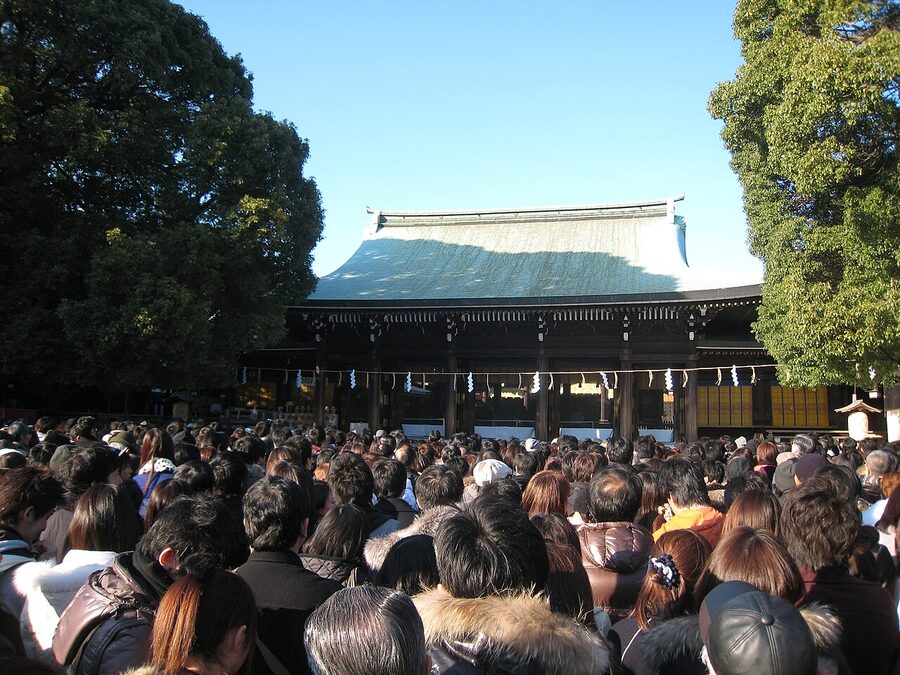
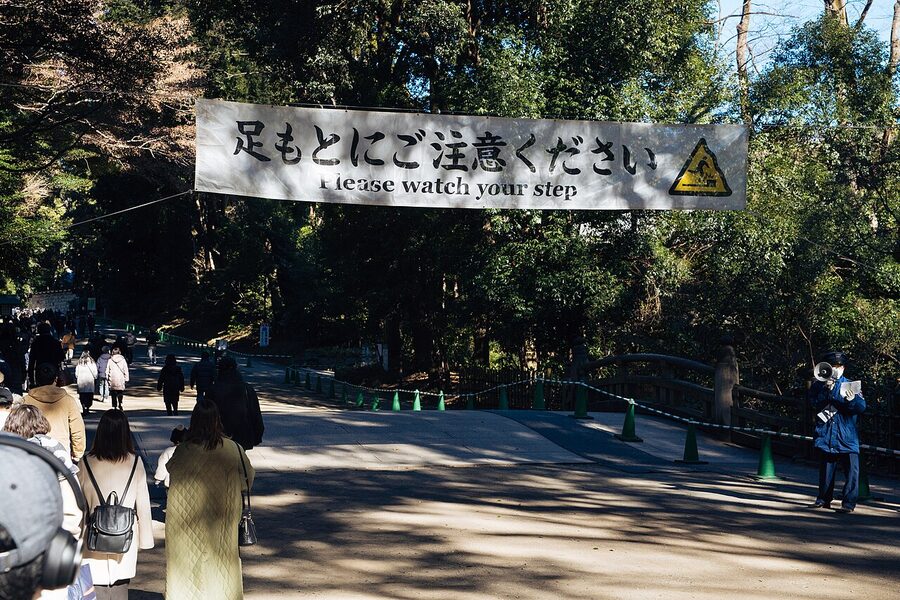
Sometime over the first three days of January, almost every Japanese person and a high percentage of visitors do hatsumode: the first shrine visit of the new year. At big shrines (Meiji Jingu in Tokyo, Fushimi Inari in Kyoto, Sumiyoshi Taisha in Osaka, Atsuta Jingu in Nagoya), the lines run for hours on the 1st and 2nd. Smaller neighbourhood shrines have lines you can walk through in five minutes.
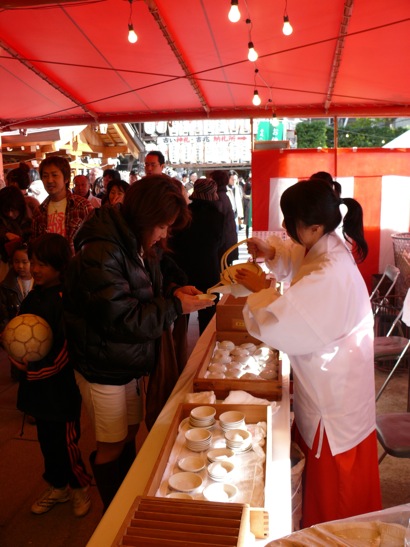
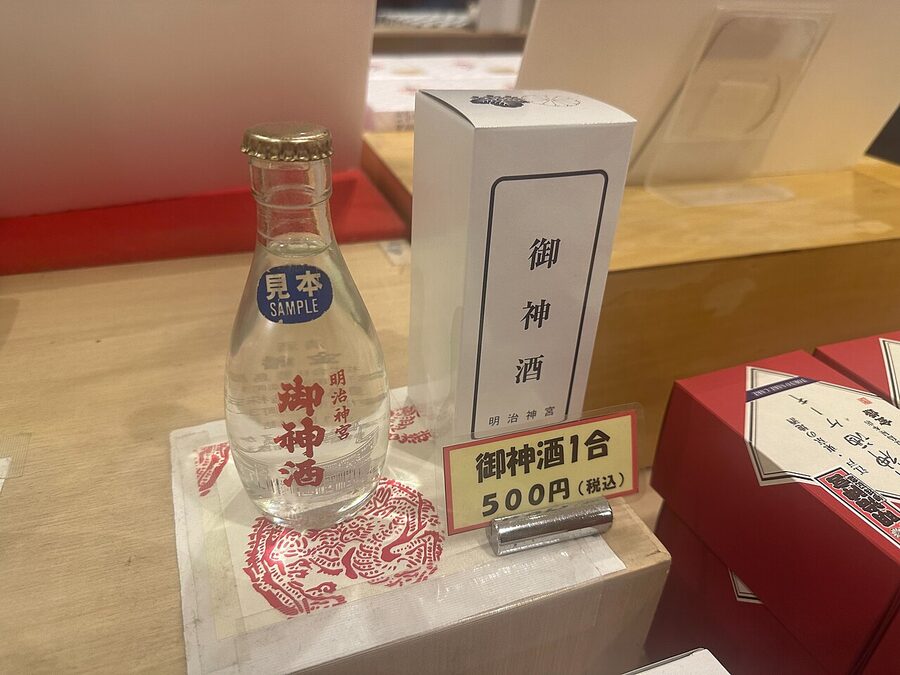
At many shrines, after you have made your offering, rung the bell, clapped twice, bowed, and made your wish, you can take a small paper or wooden cup of omiki from a counter near the main hall. Omiki is consecrated sake, sometimes a few millilitres, sometimes a proper sip. It is usually free; some shrines collect a small ¥100–300 donation. The cup is often disposable: a small folded paper cup, sometimes a thin wood masu stamped with the shrine’s crest that you can keep as a souvenir.

What omiki actually is
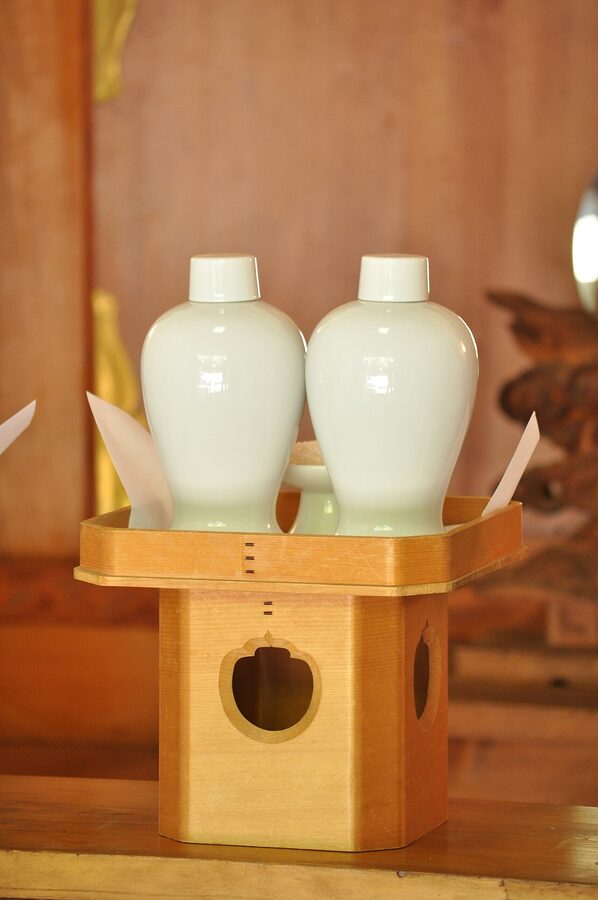
Omiki literally means “honoured spirit/sake.” It is sake that has been offered to the kami at the shrine altar before being shared back with worshippers. The exchange is the heart of Shinto: you offer the kami something, the kami consumes the spirit of it, and you receive what is left as naorai, communion. Drinking omiki is the same idea as taking a wafer at communion in a Catholic church. You are sharing a meal with the divine.
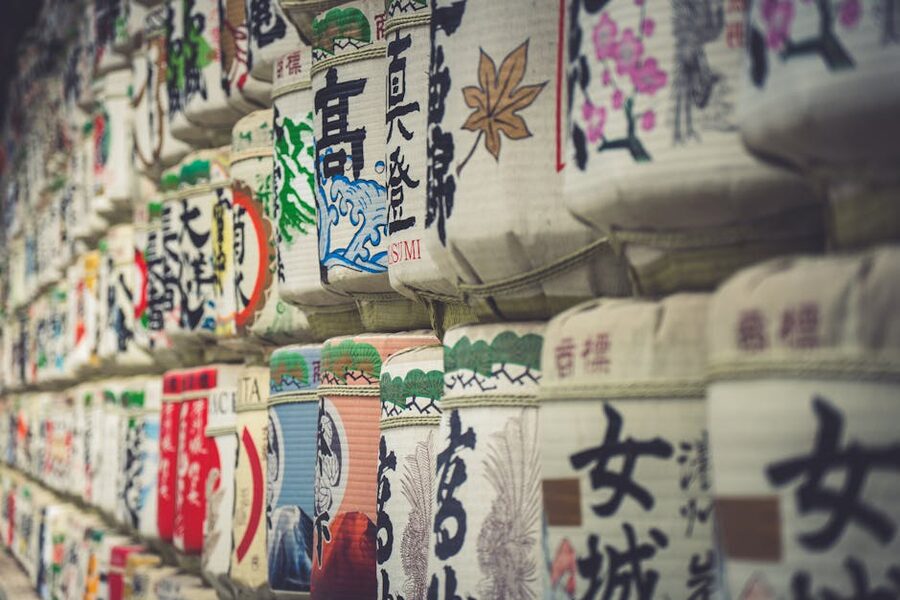
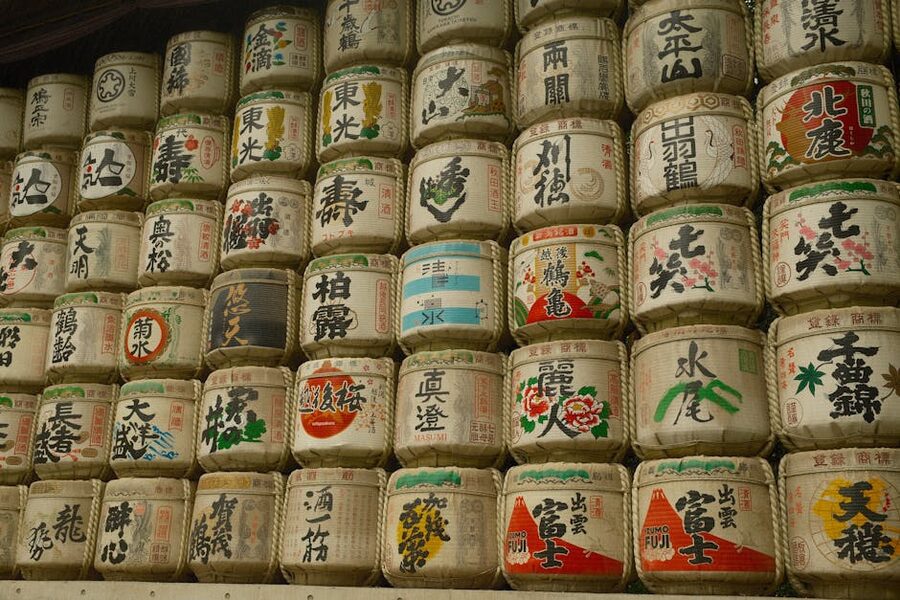
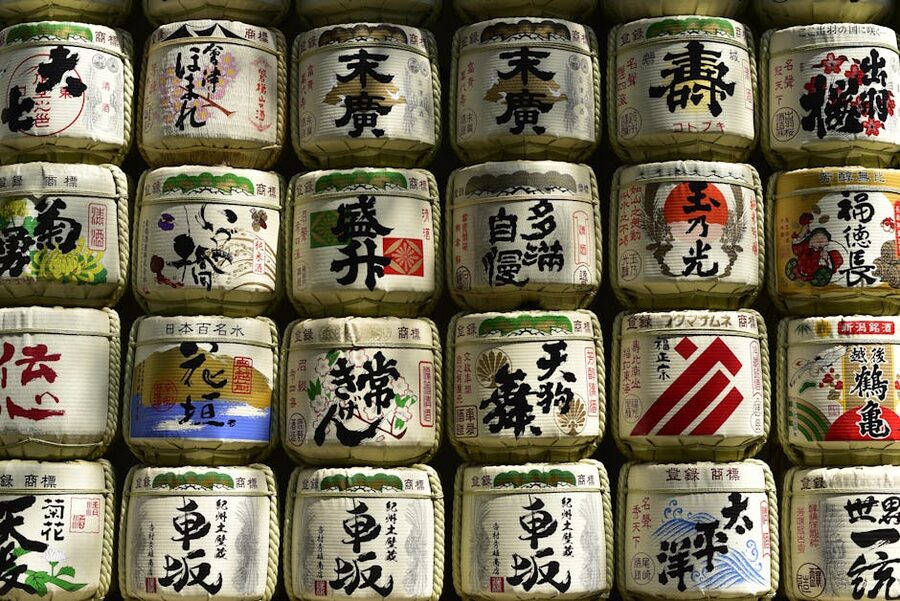
The sake itself is usually a regional brew donated by a brewery the shrine has a long relationship with. At Meiji Jingu, the omiki is often Hakushika or one of the other Hyōgo Nada-region houses; the giant Nada-region barrels stacked in the Meiji Jingu approach are an advertising display from the same breweries. At Fushimi Inari in Kyoto, the omiki is Kyoto-Fushimi sake, often Gekkeikan or Tamanohikari, both based within walking distance of the shrine. At Sumiyoshi Taisha, it is one of the Osaka-region breweries.
Etiquette in 90 seconds
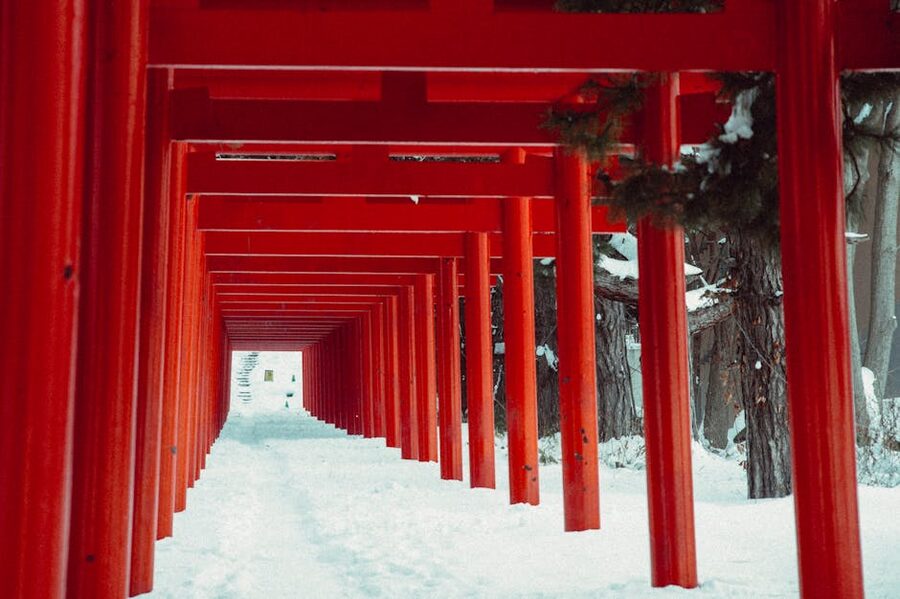
Bow once before entering the torii. Walk the side, not the centre, of the path (the centre is the kami’s path). Wash hands and rinse mouth at the chōzuya font near the entrance, single-handed dipper, water poured over both hands and into the cupped left hand for the mouth, never directly into the mouth. At the offering box, throw a coin (5-yen coins are good luck for their pun: go-en means both “5 yen” and “good fortune”), bow twice deeply, clap twice, bow once more.
The omiki cup, when offered, is taken with both hands, raised slightly to acknowledge the kami, drunk in one or two sips, the cup placed back on the tray it came from. There is no toast, no kanpai; this is a sacrament, not a cheers. If you do not drink alcohol, it is acceptable to lift the cup to the lips without sipping. Nobody checks.
Where to do hatsumode for the omiki specifically
If the shrine sake is the part you care about, smaller shrines often pour more generously than the big famous ones. At Meiji Jingu on 1 January at noon, the omiki is a thimble; at a 5,000-visitor neighbourhood shrine on 3 January at 10:00, you can sometimes get a full small cup. The trade-off is that the famous shrines have the historic atmosphere and the brewery connection, while the small shrines have the human-scale ritual.
For travellers who want the experience without the crush, my recommendation is a mid-sized shrine on the 3rd or 4th of January, mid-morning. Yasukuni in Tokyo (controversial for political reasons; visit only if you’ve thought it through), Hie Jinja in Akasaka, Kanda Myōjin near Akihabara. In Kyoto, Yasaka Shrine near Gion or Heian Jingu. In Osaka, Sumiyoshi Taisha is huge, but Ikukunitama in the south is human-scale. The omiki is at all of them. So is a much shorter line.
.jpg)
The shogatsu hush: drinking from 2 to 5 January
If you are travelling in Japan during the first week of January, the practical reality is that a lot of things are closed. This is the period that quietly dictates a sensible Japan drinking itinerary: front-load the bonenkai-week energy in late December, leave the first three days of January for shrine visits and otoso, then plan the bar crawl from 4 January onwards. The shogatsu shutdown runs roughly from the evening of 31 December to the morning of 4 January. Department stores reopen on the 2nd or 3rd; chain konbinis stay open all the way through; small independent restaurants and most independent izakayas are dark. Many of the bars I recommend in the Tokyo drinking guide close 30 December through 4 January.
What this means for a traveller: the first three days of January are not the time to plan a sake-bar crawl. It is the time to plan around the opposite. Shrine visits work. Daytime walking works. A long lunch at a hotel restaurant works (hotels stay open). For drinking specifically, your options narrow to four:
- Hotel bars. The cocktail bars at the Park Hyatt, Mandarin Oriental, Aman, Ritz-Carlton, and similar-tier hotels run their normal hours from 1 January and are an excellent place to ride out the otherwise-quiet city. The bartenders often have a New Year cocktail on (more on which below).
- Chain izakayas. The big chains (Watami, Torikizoku, Isomaru-suisan) stay open. Not the romantic option, but they pour and serve.
- Department-store sake counters. Mitsukoshi, Isetan, Takashimaya, Hankyu. Once they reopen on the 2nd or 3rd, the basement-floor liquor counters do small free pours and have New Year limited-edition releases worth tasting.
- Sake breweries that open for visitors. Some Kyoto-Fushimi and Nada-region breweries stay open during shogatsu and have a hatsumode-aligned tasting on the 2nd or 3rd. Day-trip breweries from Tokyo mostly close, though. The sake label guide is useful before any of these tastings: a fluently-read kimoto-style label or a junmai-daiginjō ratio number changes which bottle you’d choose at a brewery shop.
The hush is a feature, not a bug. Tokyo is louder for 49 weeks of the year than any city its size has any right to be. Shogatsu is the three days of silence that pay it back. You walk down a major street and the only sound is the wind in the dried bamboo decorations on the shopfronts. It is worth experiencing on its own terms even when the bars are dark.
Shinnenkai and taru-zake: the second wind, mid-January
By 5 or 6 January, the country wakes up. Salarymen go back to work. Schools restart on the 7th or 8th. And the next round of drinking starts: shinnenkai, the new-year party. Where bonenkai is a noisy farewell to the year that just ended, shinnenkai is a slightly more sober welcome to the year that’s begun. Companies hold them. So do school clubs, sports teams, neighbourhood associations.
The drink at shinnenkai is often taru-zake, cedar-cask sake. Taru-zake is regular sake that has been transferred into a cedar wood barrel for two or three days, picking up a strong, almost piney aroma from the wood. It is not subtle. The cedar absolutely overpowers anything delicate underneath, which is why almost no premium junmai or daiginjō ever gets put into a cask, because the cedar would erase the brewery’s hard work. Mid-grade junmai or honjozo handles it well. The result is woody, slightly resinous, dry. It pairs beautifully with the salt-edged corporate-banquet food: tempura, sashimi, grilled fish.
Taru-zake is served in a masu, a small square wooden box, often cedar to match. Some bars and shinnenkai venues add a pinch of salt to one corner of the masu rim. You sip from the opposite corner, and you take a tiny grain of salt on the lip with each sip. The salt sharpens the cedar. It is the kind of thing that sounds too try-hard until you actually do it, and then it makes complete sense.
The brewery brands worth knowing
If you want to taste taru-zake outside of a corporate banquet you weren’t invited to, the easiest places are sake bars in early January and February. Tokyo’s specialist sake bars usually rotate a taru-zake on for the New Year stretch. Look for: Kiku-Masamune from Kobe (the most established taru-zake brewery, has been doing cask ageing since the Edo period), Hakushika from Nada, or any of the smaller Kyoto-Fushimi houses for a softer style. In North America, Ichi-no-Kura from Miyagi is the most likely to surface in a Japanese restaurant’s New Year menu.
Order taru-zake cool or at room temperature, never warm. The cedar volatiles are already big, and warming releases more, which is too much. Cool with a single ice cube is acceptable in summer, but in January the room temperature is doing the right work.
Kagami-biraki: the cask split, around 11 January

If you want one ceremonial sake event from the New Year cycle that you can actually attend as a visitor, this is it.
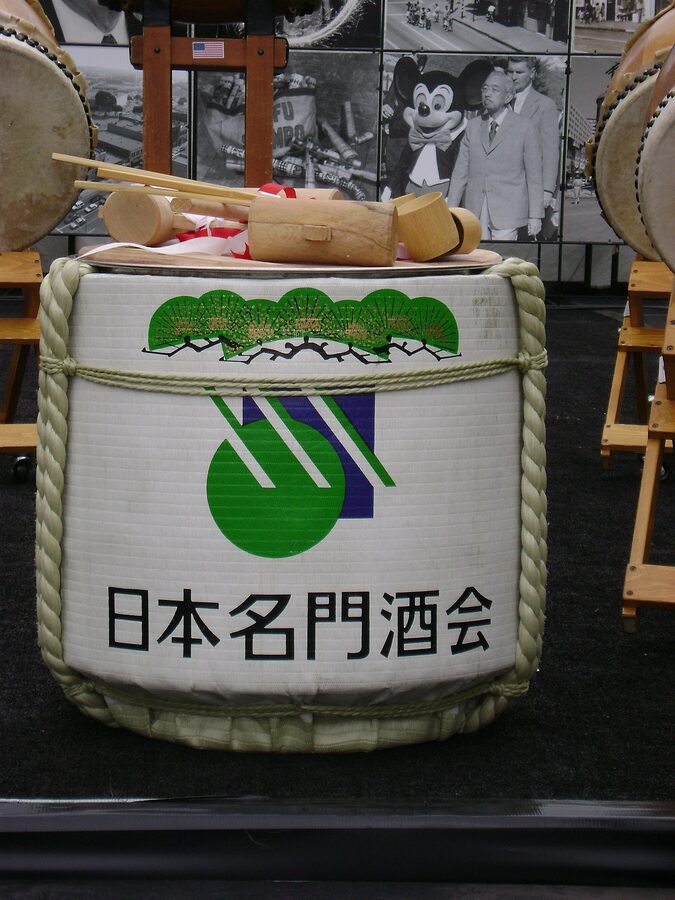
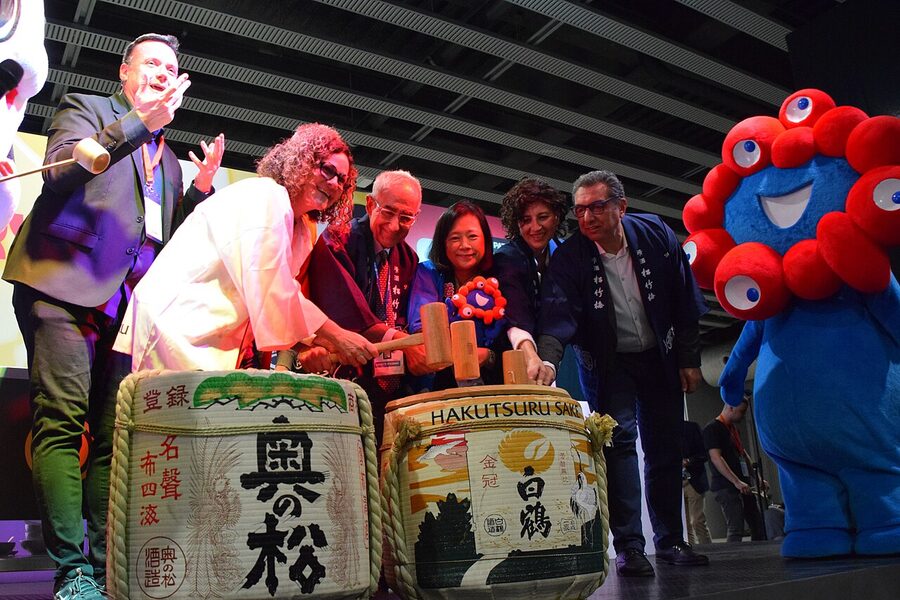
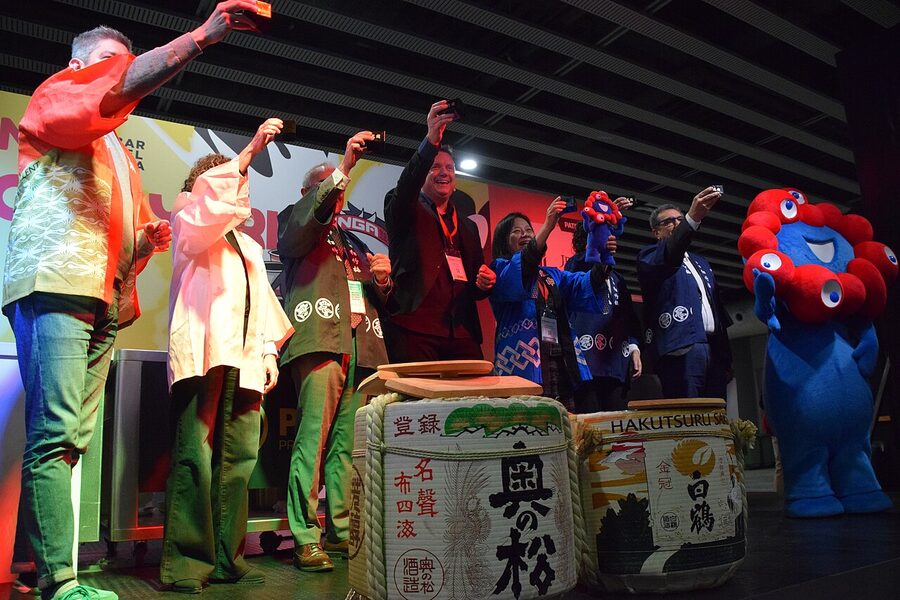
Kagami-biraki means “opening the mirror.” The “mirror” is the flat round lid of a cedar sake cask: round, polished by the brewer’s tools, sitting like a wooden mirror across the top. The ceremony is straightforward: a small group gathers, raises wooden mallets together, and on a count strikes the lid open. Sake gushes out. Everyone holds their masu boxes underneath, scoops the sake into them, lifts a toast, drinks.
The date is loosely set at 11 January, the date when shōgun Tokugawa Ietsuna’s death anniversary fell in 1680, but in practice ceremonies happen anywhere from the 7th to mid-January. Companies hold them. Dojos hold them at the start of the training year. Wedding venues sometimes have them. The Prime Minister opens one at major political events. The Cabinet Office routinely posts the photos.

Where to attend one as a visitor
Public kagami-biraki ceremonies are surprisingly easy to find in early January. Major dojos in martial arts (Kodokan judo in Bunkyō-ku Tokyo, Aikikai Hombu Dojo in Wakamatsu-chō) hold one at the start of their first training day, usually around 8–11 January, and outsiders can sometimes attend if they ask in advance. Some sake breweries, especially in Kyoto-Fushimi and Nada, hold one on a public day. Hotels sometimes have one in the lobby with a small sake giveaway around the 10th of January.
The easiest paid entry is a sake-festival-style event. The Tokyo International Sake Challenge typically holds a small kagami-biraki opening at one of its January events; tickets ¥3,000–5,000 with multiple cup-pours included. Niigata’s larger New Year sake events run from mid-January, and the Niigata sake region is where the largest concentration of these events happens.

Where you can taste otoso as a traveller
Reading about otoso is one thing. Drinking it is another. If your trip overlaps with the first week of January and you want to actually try the spiced sake, here are the verified options.
Sake bars in Tokyo
The specialist sake bars in Shibuya, Shimbashi, and Asakusa often pour otoso through 7 January. Some of the better candidates are listed in the Tokyo sake bars guide. Walk in, ask “otoso wa arimasu ka?” (do you have otoso?), and most will say yes for the first week of January and no after. Single-cup tasting price is ¥500–1,000.
Department-store basement liquor counters
From 2 or 3 January, the depachika liquor counters at Mitsukoshi Nihonbashi, Isetan Shinjuku, Hankyu Umeda, and Daimaru Tokyo all set up small otoso displays. Some offer free tastings. The bottled pre-made otoso (Asahi-Shuzo, Nakagawa-Shuzō, Kiku-Masamune all make versions) is a useful souvenir at ¥1,500–2,500 a 720ml bottle.
Hotel restaurants
Higher-end hotel restaurants serve otoso at New Year’s breakfast and brunch on 1, 2, and 3 January. The Imperial Hotel’s traditional Japanese breakfast comes with a small cup. The Park Hyatt Tokyo’s Japanese breakfast does too. Set price is steep (the Park Hyatt breakfast is around ¥6,000), but the otoso comes properly served, with a kaiseki-style osechi assortment and a chef’s explanation if you ask.
The Ritz-Carlton Tokyo Martini and the modern angle
The most interesting recent twist on otoso is happening in cocktail bars. At the Ritz-Carlton Tokyo’s Hinokizaka restaurant, head bartender Kentaro Wada built a Japanese Martini around the spice profile of otoso after a New Year’s Eve guest brought him an unfinished cup and asked him to do something with it. The drink uses Saijo Shiro mirin from the 19th-century Baba Honten brewery in Chiba, plus shiso and yuzu bitters to replicate the otoso herb signature, stirred with gin and vermouth. The cocktail is sweet and dry at once, and it has stayed on the bar’s signature menu year-round. Around ¥3,000 a glass; the bar is open all year, including through the shogatsu shutdown.
A few other Tokyo bartenders run otoso-influenced specials in early January. The Bellwood in Shibuya runs a herbal infusion drink that lifts the same Chinese-medicinal note. Bar Benfiddich in Nishi-Shinjuku, which is built around the bartender’s own herbal garden, occasionally does an otoso-adjacent cocktail in the first week of January. The full Tokyo cocktail map sits in the Tokyo craft cocktail bars guide.
The unromantic side: drinking and the Japanese New Year crash
One more thing worth saying. The Japanese New Year drinking culture is deeply atmospheric, and it can also leave a wake. Bonenkai season generates real social drinking pressure. Some employees go to four or five parties in two weeks. The nomihōdai all-you-can-drink format ensures volume. Hospital admissions for alcohol-related issues spike noticeably in the second half of December.
You will see this if you watch the late trains in Tokyo from 18 December to 28 December. Salarymen asleep on the platforms, some who have missed the last train and will catch a taxi or wait for first train at 05:00. The vending machines on the platforms shift to selling cup ramen and electrolyte drinks. The oshoyo, the morning station-platform crowd, looks like it has been through something.
If you are travelling and you find yourself in a bonenkai-adjacent gathering, a few practical things help:
- You don’t have to keep up. Saying watashi wa amari nomenai (“I can’t drink much”) is a complete and respected answer. Most Japanese drinkers will accept it without further pressure.
- Oolong-hai (oolong tea) is what Japanese non-drinkers order when everyone else is drinking. It looks similar to a highball; nobody comments.
- The otsukare-sama toast at the start is more important than the drinking that follows. Make the toast properly (raise glass slightly below your senior’s, eye contact, sip), and the rest is your call.
- Pace yourself. Japanese drinking is a marathon. Six rounds is normal at a bonenkai. Eight rounds is a nijikai. Drink water between every round.
This balance, between celebration and boundary, is part of the New Year drinking culture, not separate from it. The same calendar that makes otoso a sacrament makes bonenkai a flood. Both are real. The traveller who reads only the otoso side and not the bonenkai aftermath misses half the picture; the traveller who sees only the December chaos misses the quiet alchemy of the 1st-of-January cup.
How to bring otoso home
If you want to do otoso at home after the trip, the supplies are surprisingly portable. Tososan tea bags weigh nothing and pack flat. Buy them at a Japanese supermarket from late December (Don Quijote, Aeon, the basement of any department store) for ¥200–500 a packet. Hon-mirin in 500ml or smaller bottles is available at the same supermarkets and is checked-luggage friendly. A small lacquer cup or two from a Kyoto handicraft shop completes the set; expect to spend ¥3,000–8,000 for a usable single cup, more for a full tosoki.
Steep a fresh tososan tea bag in 300ml of mirin or a sake-mirin blend on the evening of 31 December, refrigerate overnight, and pour a small cup before breakfast on 1 January. The herbs hit the same way 1,800 kilometres from Tokyo as they do in a Kyoto living room.
What does not travel as well is the social shape: the family in line, the sequence youngest first, the eastern bow, the spoken phrase about household and village. The drink is a vessel for a thing that lives in the room with the people in it. Hua Tuo gave Cao Cao a herbal sake; the herb mix made it medicinal, but what kept the recipe alive for eighteen hundred years was the cup passing in order around the table. You can do that anywhere. It just takes a little choreography.
The longer arc
Hua Tuo died in 208 AD, executed by Cao Cao in a fit of paranoid rage, the historians say. The last letters he wrote on medicine were burned. What survived him, somehow, was a herb recipe written for a difficult patient, carried out of Han China during the chaos of the Three Kingdoms wars, kept alive in monastery scrolls, picked up by the Heian aristocracy in 9th-century Kyoto, broadcast to the merchant class through Edo-period pharmacy goodwill, and now sold in supermarket tea bags from Aeon stores throughout Japan in late December.
The first sip of the year, in many Japanese households, is still that recipe. The cup goes around in order. The youngest drinks first. The grandfather drinks last. The old physician’s prescription, written for a warlord who probably did not deserve it, ends up in the hands of an eight-year-old in Kyoto, in 1936, and again in the hands of an eight-year-old somewhere in Japan in 2026. Eighteen hundred years of drinking culture, condensed into one small lacquer cup of medicinal sake, drunk silently before the first bowl of osechi.
If your travels in Japan happen to overlap with that morning, set an alarm for sunrise and find your way to a household that will let you in for breakfast. If they don’t, find a hotel that pours one. If you can’t get to either, walk into a small sake bar on 2 or 3 January and ask. Most pour. Drink it slowly, in three sips, facing east if you remember. Then go on with the day.
 Drinking CultureWhy I Stopped Clinking Glasses in JapanThe first time I got a Japanese toast wrong, I was at a wedding reception in Yokohama. Ten of us…
 Drinking CultureKonbini Drinks Are a Whole Trip StrategyJapan has roughly 56,000 convenience stores. That's more outlets than McDonald's has worldwide, and the country sells about a third…
 Drinking CultureIs Drinking Alone in Japan Awkward as a Woman?Is drinking alone in Japan awkward as a woman? I asked myself that on the bullet train to Tokyo with…